

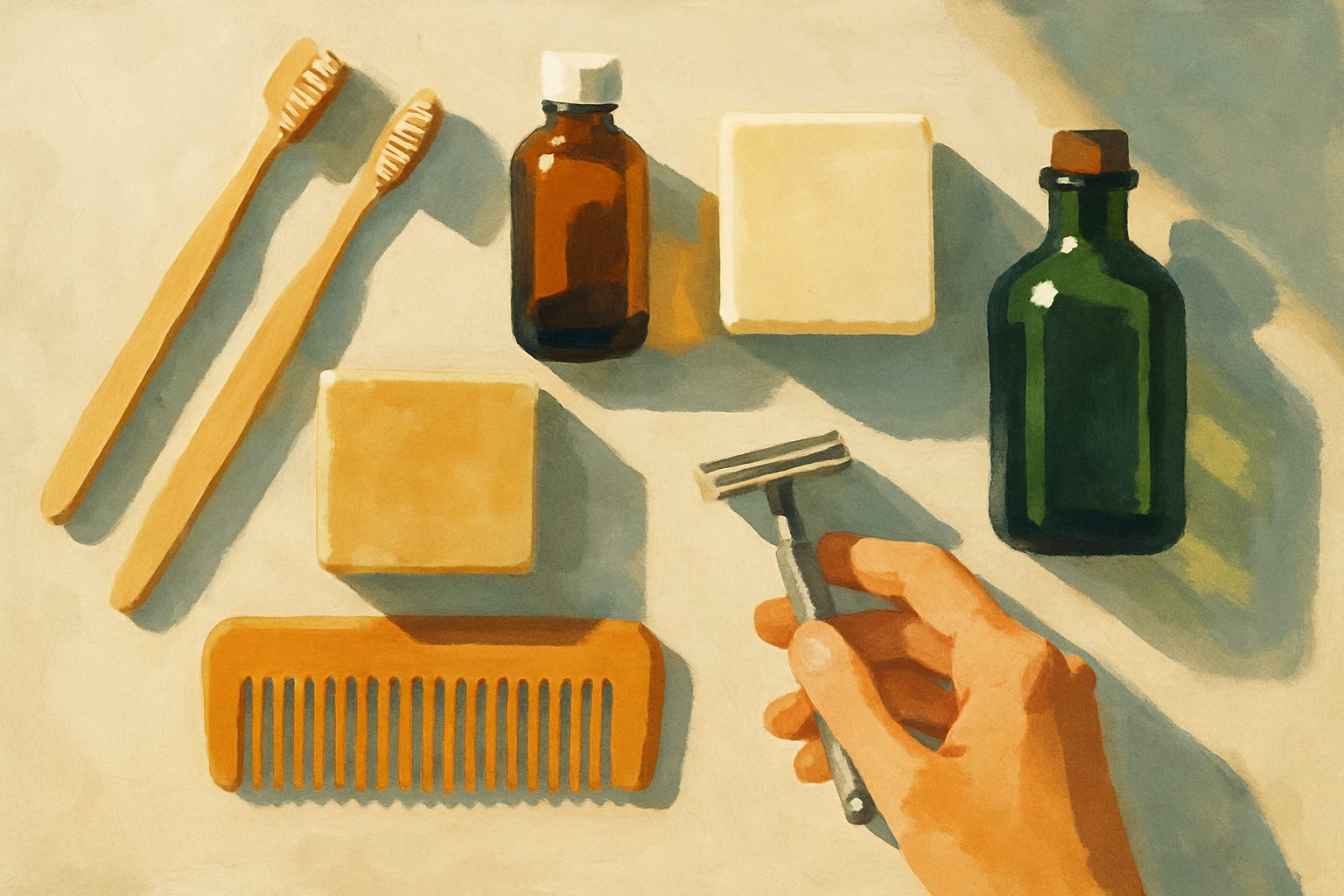
Open your bathroom cabinet right now. Go on, I’ll wait. Count the plastic bottles, tubes, and packages staring back at you. Shampoo, conditioner, body wash, toothpaste, razors, cotton swabs, floss containers. Most of us never think twice about any of it, because the kitchen gets all the sustainability attention. But your bathroom is quietly one of the worst offenders in the house.
Here’s the thing that surprised me most while researching this: people recycle way more in the kitchen than they do in the bathroom, even when the exact same materials are involved. It’s not a willpower problem. It’s a habit problem. Nobody set up a recycling bin next to the sink, so the plastic just goes in the trash on autopilot. This list fixes that, one swap at a time, without turning your morning routine into a science project. 🌿
Why your bathroom is a bigger plastic problem than your kitchen
A widely cited 2014 report from Johnson & Johnson’s Care to Recycle initiative found something wild: 95 percent of people say they recycle in the kitchen, but only about half report doing the same in the bathroom. Same plastic, same recycling truck, completely different behavior. That gap alone tells you the bathroom has been sitting in a blind spot for years. 🪥
Landfill space isn’t the only problem here. In April 2026, the U.S. Environmental Protection Agency named microplastics a priority contaminant for the first time in agency history, adding it to the draft list of substances the agency is formally evaluating in drinking water. 💧 A lot of that contamination starts, quite literally, in bathrooms. According to a 2026 guide on the topic, the cosmetics and personal care industry uses roughly 16,000 tonnes of plastic microingredients a year worldwide, much of it in exfoliating scrubs and foaming cleansers that wash straight down the drain. 🚿 Most treatment plants simply can’t filter particles that small, so they pass right through into rivers and oceans, a mechanism Wikipedia’s overview of microplastics explains in more depth if you want the full picture.
A few numbers worth sitting with:
Roughly half of bathroom users don’t recycle items they would automatically recycle in the kitchen
A single bottle of facial scrub can contain hundreds of thousands of plastic microbeads
Most wastewater treatment plants can’t filter plastic particles under 0.3 millimeters
The cosmetics industry alone uses thousands of tonnes of plastic microingredients annually
Microplastics are now formally on the EPA’s radar as a drinking-water contaminant
The five-minute swaps you’ll adopt without noticing
Start here, because these are genuinely painless. You won’t remember what the plastic version felt like within a month. 🧴
Bamboo toothbrush: the American Dental Association’s own figures show that roughly one billion plastic toothbrushes get thrown away every year in the United States, creating about 50 million pounds of waste. A bamboo handle breaks down in months, not centuries
Bar soap over bottled body wash: no bottle means no plastic, and modern formulas lather just as well as anything from a pump
Safety razor: the handle lasts decades; you only ever replace the metal blade, which is fully recyclable
Refillable deodorant: buy the case once, then just swap the stick
Solid dish and hand soap: same idea, less packaging, and it lasts longer per ounce than you’d expect
I switched to a safety razor two years ago and genuinely forgot plastic cartridge razors were ever a thing I bought. 💡 That’s the goal with every swap on this list: not sacrifice, just a slightly different object doing the exact same job. 🪒
The swaps that take a little more commitment (but you won’t miss the old version)
These need a short adjustment window, usually two or three tries before you’re sold. Give them that chance before writing them off. 🔄
Shampoo and conditioner bars: your hair type matters here, and it can take a few washes to find the right formula, but once you do, one bar often replaces two or three plastic bottles
Toothpaste tablets: bite, chew, brush. No tube, no cap, and most come in compostable or reusable glass containers
Menstrual cups or period underwear: a single cup can last up to a decade, which means it eventually replaces thousands of disposable products
Reusable cotton rounds: wash them with your regular laundry instead of tossing a new one every morning
Bamboo cotton swabs: functionally identical to plastic ones, and one of the lowest-effort swaps on this entire list
The menstrual cup is the one people hesitate on longest, understandably, since it’s the biggest behavior change here. But it’s also the swap with the single biggest plastic-avoidance payoff of anything on this list. 🌍 Worth trying at least once before ruling it out. ♻️
The plastic hiding in your cleaning cabinet
This is the part most plastic-free bathroom guides skip entirely, which is a shame, because it’s where a lot of the hidden waste actually lives. 🧽 The stuff under the sink matters just as much as what’s in the shower caddy. 🗄️
Cleaning spray concentrates: buy one reusable glass bottle, then refill it with concentrate tablets instead of buying a new plastic trigger bottle every time
Bamboo or recycled toilet paper: same function, dramatically less virgin plastic and packaging involved in production
Glass storage jars: swap plastic organizer bins for glass or metal, which also happen to look nicer on an open shelf
Natural loofahs or washcloths: plastic mesh puffs shed microplastic fibers every single time you use them
Compostable trash liners: even your bathroom bin liner is usually plastic, and it doesn’t have to be
If you want the deeper mechanics of swapping out chemical-heavy sprays, we’ve covered seven things in your home that are secretly wrecking the planet, including the bathroom cabinet. And if you’re curious what’s already sitting in your kitchen that could replace half your spray bottles, five cleaning products you already own that beat chemical sprays is worth a look before you buy anything new.
Quick question for you: when’s the last time you actually checked what’s in your all-purpose cleaner? 🔍 Most people never do, and it’s usually the single worst offender in the whole room.
How to actually make the swaps stick
Here’s where most plastic-free guides fail people. They dump twenty product recommendations on you and expect you to buy everything at once, which is expensive, overwhelming, and honestly a little wasteful in its own right. 📉 The point isn’t the shopping list. It’s the habit. 🔁
Use up what you already own first. Throwing away a half-used plastic bottle to buy the “greener” version defeats the purpose
Swap one category at a time. Finish the shampoo, then buy the bar. Finish the razor cartridges, then buy the safety razor
Set a trigger, not a deadline. “When this runs out” works better than “starting next month,” because it removes the willpower requirement entirely
Track what actually sticks. Some swaps you’ll love immediately; others won’t fit your routine, and that’s fine
Don’t chase perfection. A bathroom that’s 70 percent plastic-free beats a plan so strict you abandon it in three weeks
For the habit-formation side of this, ten everyday swaps designed to actually stick walks through the psychology of why some changes last and others don’t. And since showers are the other big resource sink in this room, why hot showers cost more than you’d think, and how to fix that without suffering pairs nicely with everything above.
Pick one item from your bathroom cabinet right now, the very next thing you’re due to run out of, and decide what its plastic-free replacement will be before you actually need it. 🎯 What’s the first thing going?