

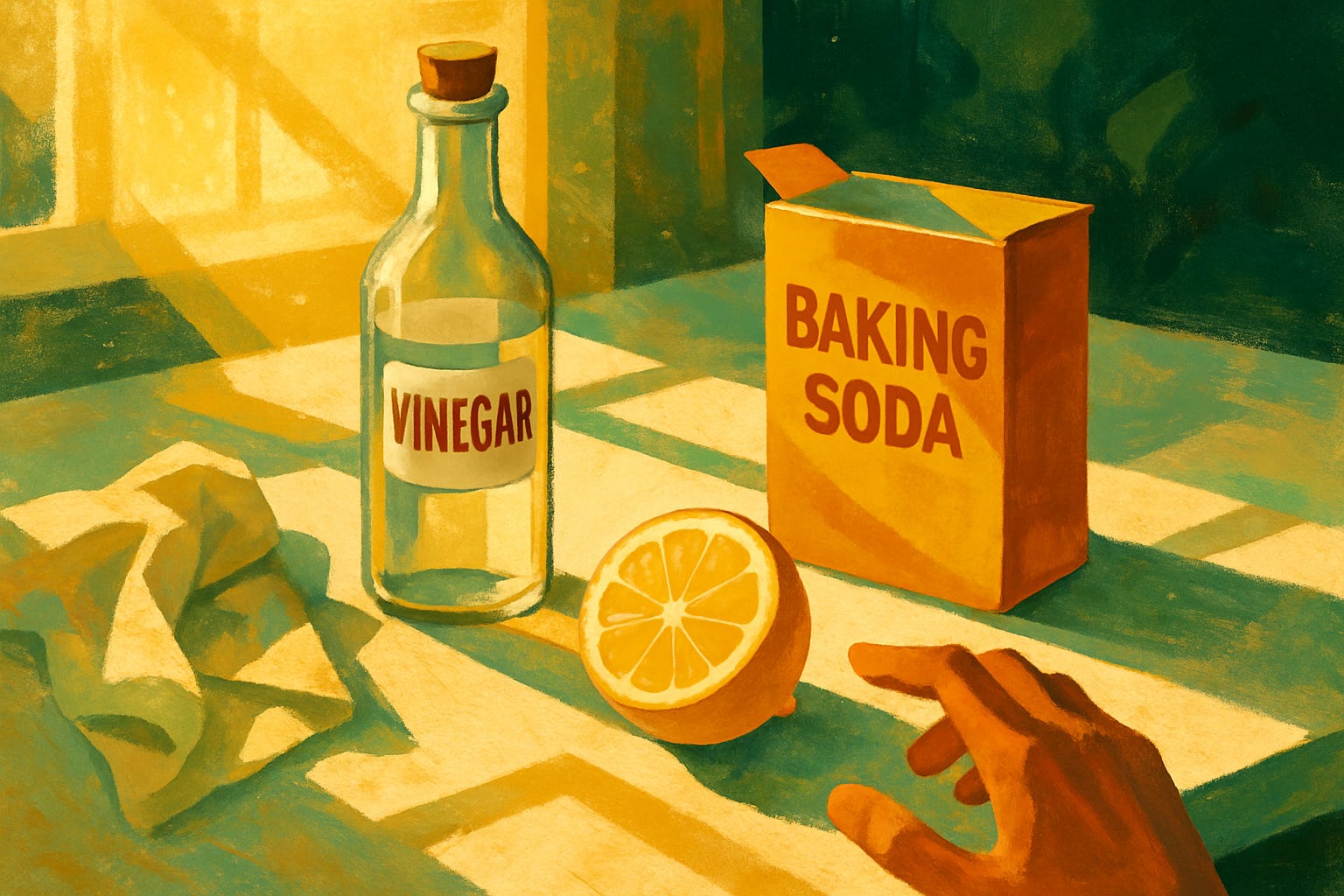
I used to think “natural cleaning” meant a slightly less effective version of the real thing, like decaf coffee for your kitchen counters. Then I actually looked into the chemistry, and it turns out several of the ingredients already sitting in your pantry aren’t watered-down substitutes. They’re the original cleaners, and in some cases they outperform what’s in the spray bottle under your sink. That matters more than it used to: a peer-reviewed analysis published in Chemosphere found that 30 common cleaning products released 530 unique volatile organic compounds, and 193 of those were flagged as hazardous, according to the Environmental Working Group’s research. None of that is in your baking soda box. 🧽
White vinegar
Vinegar is the workhorse of this list, and the science backs up the reputation. Acetic acid, the compound that gives vinegar its bite, has a pH around 2.0, low enough to make surfaces genuinely inhospitable to bacteria. Research from the American Society for Microbiology found that acetic acid effectively kills strains of tuberculosis-causing bacteria, and researchers suggested the same likely holds for most other bacteria too. 🍋 It also cuts grease and deodorizes without leaving behind a chemical residue.
A few places it earns its keep:
Countertops and cutting boards (diluted 50:50 with water)
Glass and mirrors, where it leaves zero streaking
Coffee makers and kettles, dissolving mineral buildup in one cycle
Laundry, as a fabric softener alternative that also strips detergent buildup
One important caveat, and I mean this one: vinegar is not technically a registered disinfectant by EPA standards, even though it’s excellent at general cleaning and deodorizing. If you want true disinfection on a high-touch surface, pair it with one of the other tools on this list rather than relying on vinegar alone.
Baking soda
If vinegar handles the acid side of cleaning, baking soda handles everything else. It’s mildly abrasive, which makes it brilliant at scrubbing without scratching most surfaces, and it neutralizes odors instead of just masking them the way most air fresheners do. Sprinkle it in the fridge, dust it into carpet before vacuuming, or mix it into a paste for stuck-on grime in the oven.
Here’s the part people mess up: vinegar and baking soda are both excellent cleaners separately, but mixing them together in the same bottle mostly just produces fizzy, salty water. The acid and base cancel each other out, according to cleaning chemists at Live Simply’s breakdown of natural cleaning combinations. Use them back to back instead. Sprinkle baking soda on the surface first, scrub, then follow with a vinegar rinse for extra disinfecting power. Two great tools, used one at a time. ✨
Castile soap
Castile soap is the one ingredient on this list that feels almost too gentle to be useful, which is exactly why people underestimate it. Made from vegetable oils rather than petroleum-based surfactants, a single drop diluted in water handles dishes, floors, laundry, and even body wash. It’s biodegradable, concentrated enough that a bottle lasts months, and doesn’t carry the VOC baggage that shows up in most commercial multi-surface sprays.
The one rule to remember 📋:
Never mix castile soap directly with vinegar. It’s alkaline (pH 9-10), vinegar is acidic (pH 2-3), and combining them curdles the soap into an oily, useless mess
Clean with diluted castile soap first, rinse, then spray vinegar to disinfect
Use roughly 1 part castile soap to 10 parts water for an everyday all-purpose spray
If you want a broader routine built around swaps like this, GreenInch’s guide to eco-friendly cleaning tricks that outperform chemicals walks through more combinations room by room.
Hydrogen peroxide
This is probably the most underrated bottle in your medicine cabinet. At 3% concentration, hydrogen peroxide is genuinely more effective than distilled vinegar or rubbing alcohol at killing bacteria and viruses, and it performs about as well as chlorine bleach against mold and mildew on porous surfaces, according to cleaning research summarized by The Maids’ guide to disinfecting with hydrogen peroxide. It breaks down into just water and oxygen, so there’s no toxic residue left behind. 🦠
It’s genuinely useful for:
Disinfecting cutting boards and toilets
Whitening grout without bleach fumes
Sanitizing toothbrushes and sponges
Removing mold on non-porous bathroom tile
Store it in a dark bottle, since light breaks it down fast, and know that once opened, it loses potency after a couple of months.
Lemon juice
Lemon juice gets sold as a miracle disinfectant online, and I want to gently correct that before you trust your kitchen sponge to it. Its low pH (around 2-3) does inhibit bacterial growth and cuts through grease and hard water buildup impressively well, but by EPA definitions it’s a cleaner and deodorizer, not a true disinfectant, per House Digest’s review of the actual science behind lemon cleaning claims. Where it shines is combined with hydrogen peroxide: two to three tablespoons of lemon juice mixed with one cup of 3% hydrogen peroxide and two cups of distilled water creates a solution that’s meaningfully more reactive than either ingredient alone, since the acidity stabilizes and boosts the peroxide’s oxidizing power. Keep it in a dark bottle and mix it fresh rather than storing a big batch.
Have you actually tried building a full cleaning kit out of these five, or does one of them feel like a step too far? If you’re ready to detox your cabinet without losing the results you’re used to, GreenInch’s guide to detoxing your cleaning routine without losing the sparkle is a good next stop. Start with just one swap this week, maybe the vinegar-and-baking-soda combo on your kitchen counters, and see how it compares to what you were using before.