

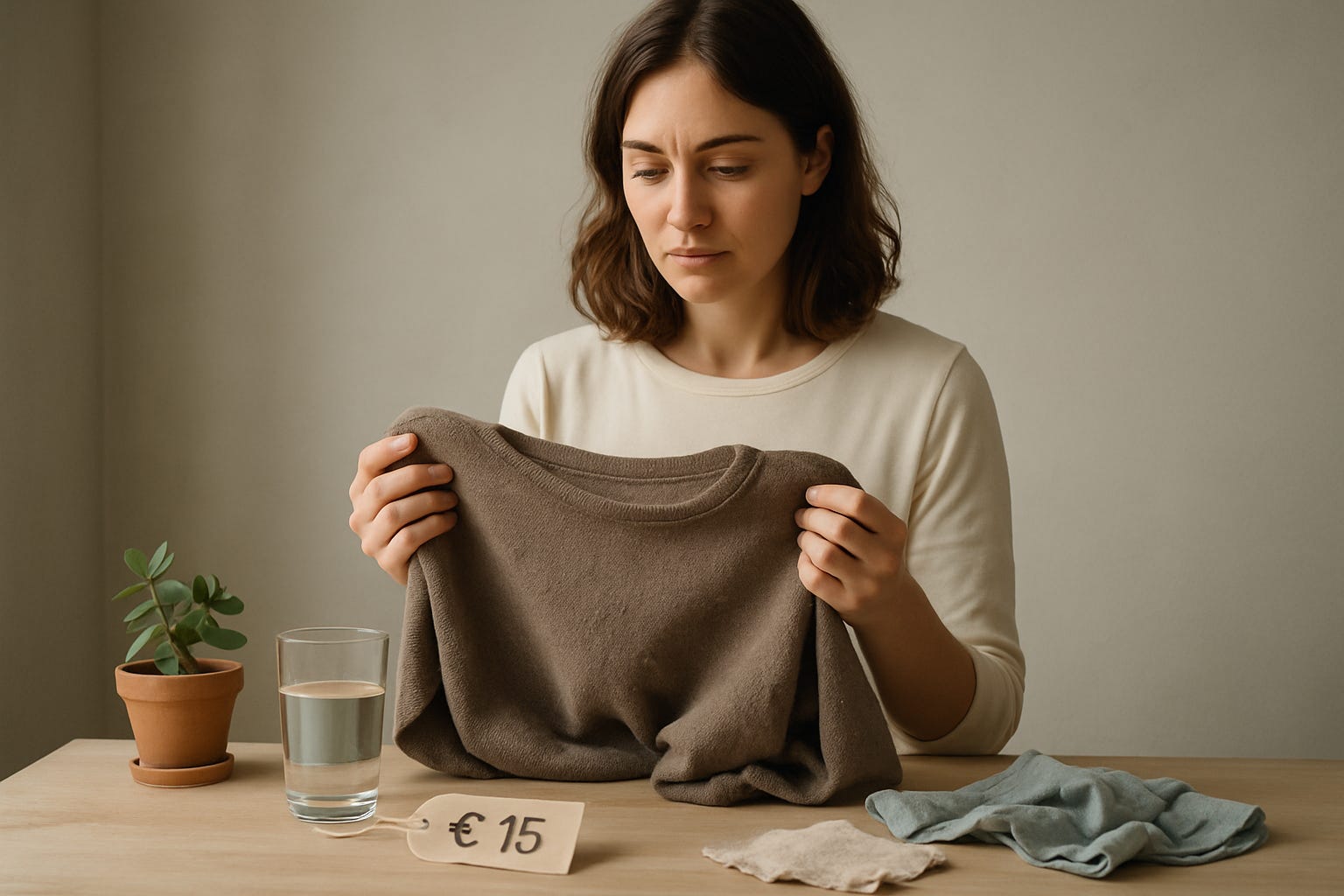
You spot it on a Tuesday scroll: a top, €15, free shipping, back in stock. It looks great in the photos. You buy it. Three weeks later it’s folded at the bottom of a drawer, worn twice, already a little pilled at the seams. This isn’t a story about your willpower. It’s the business model working exactly as designed, and the real price of that top was never €15. I want to walk through the actual math, because once you see it, you genuinely can’t unsee it.
The numbers below come from the UN Environment Programme, the European Parliament, and trade researchers who track this industry closely, not from a guilt-trip pamphlet. They’re just facts about where a garment comes from and where it ends up. Once you know them, “cheap” starts to look like a very different word. 🧵
The water hiding inside a cotton t-shirt
Start with the most invisible cost: water. A single cotton t-shirt takes roughly the amount of water one person drinks over two and a half years to produce, according to European Parliament figures cited by the Economics Observatory. Multiply that by the roughly 80 billion garments the world buys every year, and you get an industry the UN Environment Programme ranks as the second-largest consumer of water on the planet, using an estimated 93 billion cubic metres annually, enough to meet the needs of five million people. 💧
That water doesn’t just disappear either. It comes back polluted. Textile dyeing accounts for a significant share of the world’s industrial water pollution, and in major manufacturing hubs like Dhaka, wastewater full of chemical dye has literally turned canals black, as detailed in Oxfam’s reporting on the water cost of fast fashion. 🌊
A few numbers worth sitting with:
A cotton t-shirt: roughly 2.5 years of one person’s drinking water
The fashion industry overall: 93 billion cubic metres of water used per year
Dyeing and finishing: responsible for a large share of global industrial water pollution
The UK alone: uses enough water on clothing annually to fill Loch Ness
Do you know where the water for your last purchase actually came from? Almost nobody does, and that’s kind of the point of how the industry is built.
The carbon and chemicals nobody puts on the tag
Fashion is responsible for somewhere between 8 and 10 percent of global carbon emissions, more than international flights and maritime shipping combined, according to research summarized by the David Suzuki Foundation. That’s not a niche footnote. That’s a genuinely massive slice of the climate problem, tucked inside something as ordinary as a cheap top. 🌍
Synthetic fabrics like polyester make the math worse, since they’re made from petroleum and shed microplastics with every wash. Natural fibers aren’t automatically innocent either. Conventional cotton is one of the most pesticide-heavy crops on Earth, and the leather tanning process uses chemicals, including formaldehyde and various coal-tar derivatives, that don’t break down once they’re in the environment.
The parts that rarely make it into a product description:
Polyester production relies on petroleum and sheds microplastic fibers into waterways with every wash
Cotton farming is a major user of pesticides and irrigation water
Leather tanning uses chemicals that are toxic and slow to break down
Dye runoff carries heavy metals into rivers near manufacturing hubs
Less than 1 percent of clothing worldwide gets recycled back into new garments
None of this shows up at checkout. That’s the entire trick of a €15 price tag.
The wage gap behind the low price
Here’s the part that’s harder to feel good about. Someone made that top, cut it, sewed it, finished it, and got paid very little to do it. In some of the countries where garment production is concentrated, average monthly wages sit under $200, and in Bangladesh specifically, trade data compiled through Statista puts it as low as $140 a month. That’s not an hourly rate. That’s the month.
Low prices at your end require low costs somewhere else in the chain, and fabric and shipping aren’t where the biggest savings usually come from. Labor is. When a garment sells for €15 and still needs to cover materials, transport, marketing, and a profit margin, the person who actually made it is almost never the one who benefits from the discount. 👷
A few things worth knowing about who’s behind the label:
Garment work employs an estimated one in six people globally, making it one of the most labor-dependent industries on Earth
Wages in major production countries often sit well below a living wage
Enforcement of labor protections varies enormously by country and by factory
Independent audits and worker-focused certifications exist, but they’re inconsistently applied across the industry
I’m not saying every cheap garment is made unethically, because that’s not true either. But “impossibly cheap” and “someone was paid fairly” rarely show up in the same sentence, and it’s worth pausing on that before you check out.
Wear it twice: how the industry engineered disposability
The average garment today gets worn somewhere between 7 and 10 times before it’s discarded, according to the Ellen MacArthur Foundation, a steep drop from a generation ago. People are also buying roughly 60 percent more clothing than they did in 2000, while keeping each item for about half as long, per data referenced by the UN Environment Programme. That’s not a coincidence. It’s the business model. 🔁
Fast fashion brands make money by shortening the gap between “want it” and “over it.” New styles drop weekly instead of seasonally, prices stay low enough that regret feels cheap, and quality is often just good enough to survive the trip home. A useful mental tool here is cost per wear: divide the price by how many times you’ll realistically wear something, and a €15 top worn twice costs more per wear than a €70 jacket worn 100 times.
Regulators are starting to notice too. France’s parliament just passed a law, as of late June 2026, adding a per-item environmental fee to the cheapest, highest-volume online fashion platforms like Shein and Temu, alongside a ban on advertising for those brands, as reported by France 24. Whether it actually slows anything down remains to be seen, but the fact that a national government is legislating against the wear-twice-and-toss model tells you something about how big the problem has gotten.
What actually saves you money (and the planet)
None of this means you need to buy expensive clothes forever or swear off shopping entirely. It means shifting a few habits so your money buys things you’ll actually wear, repeatedly, for years. 🌱
A few starting points that genuinely work:
Before buying anything new, check secondhand first. GreenInch’s guide to thrift shopping like a pro covers exactly how to do this without wasting a Saturday
Build around a smaller, more intentional wardrobe. GreenInch’s guide to building a sustainable capsule wardrobe walks through how to do this without sacrificing style
Learn to spot real sustainability claims from marketing ones. GreenInch’s breakdown of the certifications that actually mean something is a good place to start
Do the cost-per-wear math before checkout, even just roughly, and let it talk you out of impulse buys
When you do buy new, favor brands that disclose where and how a garment was made
The genuinely good news is that dressing well and dressing sustainably aren’t opposing goals. A closet full of pieces you actually reach for, that were made by someone paid fairly, usually looks better and costs less over time than a drawer full of €15 tops worn twice each. So next time something catches your eye mid-scroll, what’s it actually going to cost you to wear it once and forget it?