

Let’s be honest about fast fashion for a moment. The fashion industry produces roughly 10% of global carbon emissions, more than all international flights and maritime shipping combined, according to UN News reporting from March 2025. Every second, the equivalent of a garbage truck full of clothing either burns or goes to landfill. And a single pair of jeans takes around 7,500 litres of water to manufacture — about as much as one person drinks over seven years.
That’s not a footnote. That’s the actual cost of a $15 pair of jeans.
The capsule wardrobe idea isn’t new — stylist Susie Faux coined the term in the 1970s — but the sustainable version of it has become something genuinely worth building in 2025. Not because it’s trendy (though it is), and not because it requires sacrifice (it doesn’t), but because it solves a real problem: most people have too many clothes and still feel like they have nothing to wear. A well-built capsule wardrobe fixes that, cuts your environmental footprint dramatically, and — here’s the part that surprises people — tends to look better than a closet stuffed with impulse buys. 🌱
This is a practical guide to building one. No judgement about where your wardrobe is starting from. Just a clear path to somewhere better.
What a capsule wardrobe actually is (and isn’t)
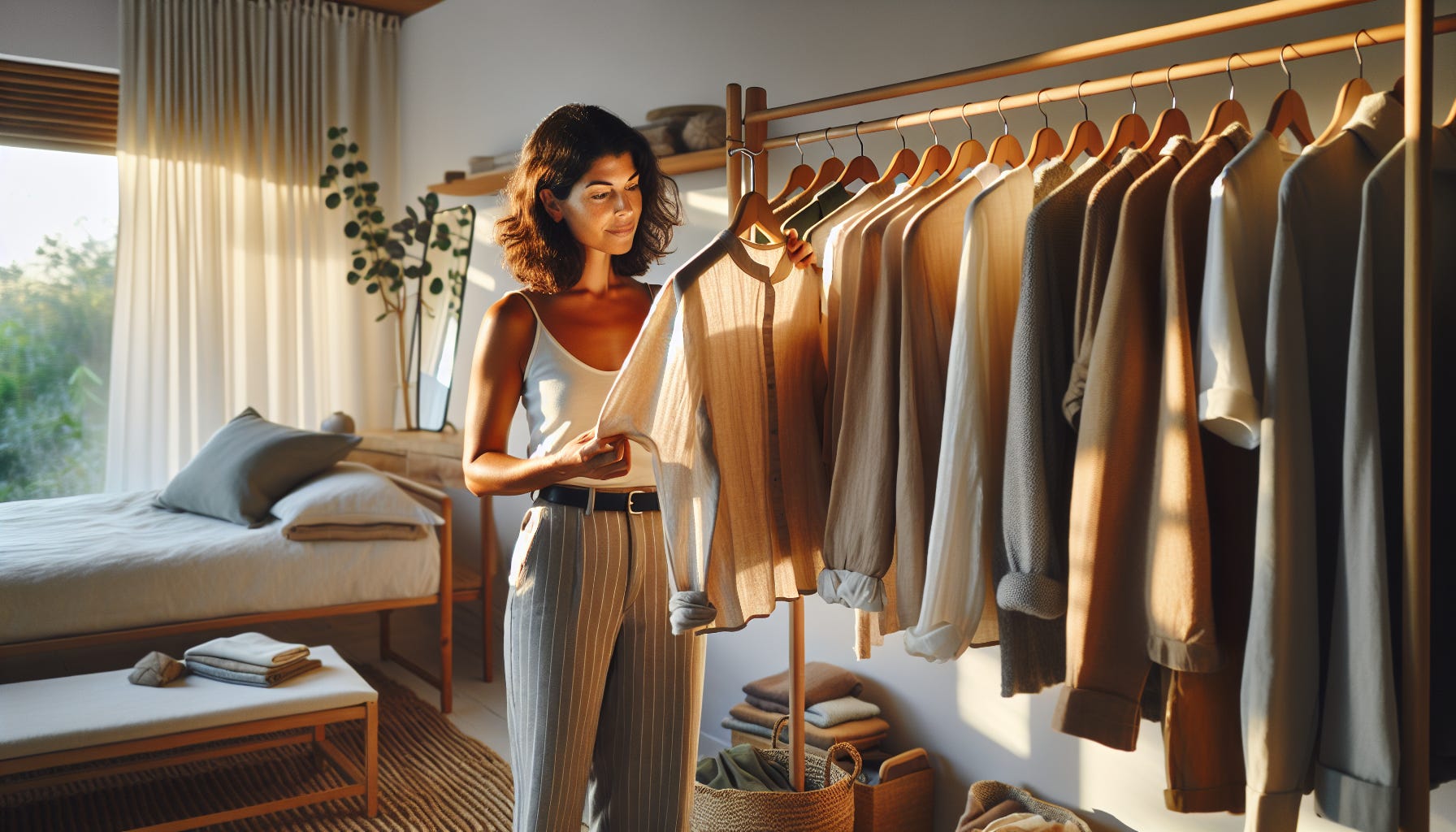
A capsule wardrobe is a small, intentional collection of clothes — typically 20-40 pieces — that mix and match easily, cover your actual life, and are chosen to last. That’s the whole concept. Everything works with everything else. You stop getting dressed by process of elimination and start getting dressed by choosing between options you genuinely like.
The sustainable version adds one more layer: the pieces are made well, from materials that don’t wreck ecosystems, by people paid fairly. That last part matters more than most labels will tell you. 🌍
A research study cited by the International Journal of Market Research, referenced in Sustainably Kind Living’s 2025 guide, found that people who completed a 3-week capsule wardrobe experiment reported less stress, greater satisfaction with their style, and stronger awareness of their own consumption habits. Those are real changes that happen fast.
What a capsule wardrobe isn’t:
A uniform — you’re not committing to wearing the same five things forever
An excuse to buy a lot of expensive new things all at once
A rigid system — the size and shape of yours depends on your actual life, not a number someone wrote in a blog post
Incompatible with color or personality — neutrals are common in capsule wardrobes because they’re versatile, but they’re not mandatory
The real discipline here is in the editing, not the buying. Before you spend a cent, you need to know what you’re working with.
The edit: what stays, what goes, and why
Spend an afternoon pulling everything out. All of it. Every item you own that qualifies as clothing goes on the bed. Then you go through it honestly — and honestly is the key word, because we all have aspirational pieces we’ve been keeping for a version of ourselves that doesn’t actually exist. ♻️
The questions to ask each item:
Have I worn this in the last year?
Does it fit my body right now, not the body I’m planning to have?
Does it work with at least three other things I own?
Is it in good enough condition to be worth keeping?
Anything that fails these questions goes into one of two piles: donate/sell (if it’s in good shape) or textile recycling (if it’s not). The European Parliament’s updated textile guidance from September 2025 notes that EU countries are now required to collect textiles separately for reuse and recycling — and similar programs exist in the US through organizations like ThredUp, Depop, and local textile drop-off points. Don’t bin wearable clothes. Sell or donate them.
What you’re left with after the edit is your actual starting point. Most people are surprised to find a solid foundation hiding under all the impulse buys they never wear. 🔎
Choosing pieces that are genuinely sustainable
Once you know your gaps, you’re ready to fill them. The sustainable part isn’t just about buying from the “right” brands — it’s about understanding what makes a garment worth owning for the long term. Two main things: material and construction.
The best fabrics for a sustainable wardrobe:
Organic cotton — uses roughly 91% less water than conventional cotton and significantly fewer pesticides, according to data cited by Earth.org
Tencel/Lyocell — made from wood pulp in a closed-loop process that recaptures and reuses the water and solvents used in production
Linen — requires very little water or pesticide and biodegrades naturally
Hemp — similar benefits to linen, durability is excellent
Recycled polyester — not perfect, but meaningfully better than virgin polyester for pieces where stretch or technical performance is needed
Avoid: virgin polyester, conventional cotton (unless it’s a secondhand piece, in which case the production damage is already done), and anything with vague “eco” claims not backed by actual certifications. 🌿
On the brand side, look for certifications that are independently verified: GOTS (Global Organic Textile Standard) for organic claims, Fair Trade or B Corp status for labor practices, and OEKO-TEX Standard 100 for chemical safety. Brands like Patagonia, Everlane, Quince, Reformation, and Organic Basics have earned genuine credibility in these areas — not because they’re perfect, but because they’re transparent about their supply chains.
Think about what you actually need, based on your audit. Most capsule wardrobes include some version of: a well-fitting pair of jeans or trousers in a dark neutral, a few quality tops that work dressed up or down, one or two blazers or structured layers, a dress or two if your life calls for it, and footwear that goes with most of what you own. The specific count matters less than the coherence.
Making secondhand your first choice
Buying new from an ethical brand is good. Buying secondhand is better — because the most sustainable garment is one that already exists. 🛍️
The secondhand market has grown enormously. ThredUp and Depop are the best-known online platforms in the US and UK respectively. Poshmark works well for higher-end finds. Vinted has grown quickly across Europe. Local charity shops and vintage stores often have better-curated stock than people expect, and the prices are genuinely lower.
What makes secondhand work for a capsule wardrobe specifically:
You’re not chasing trends, so you’re not limited to what’s currently in season
The slower pace of secondhand shopping is actually an advantage — you deliberate more before buying
Quality pieces from good brands show up regularly because well-made things get donated too, not just fast fashion
Buying secondhand extends the garment’s useful life, which the UN estimates could reduce emissions by 44% if widely adopted
The only real challenge with secondhand is consistency of supply — you can’t always find the exact thing you’re looking for. The fix is to shop with a specific list of gaps from your audit, and to check regularly rather than trying to complete the whole wardrobe in one trip.
Caring for what you have (the underrated half of the equation)
Building a sustainable wardrobe isn’t a one-time project. The sustainable part also lives in how you maintain what you own, because the environmental cost of a garment isn’t just in its production — it’s spread across its entire life. ♻️
A well-cared-for linen shirt worn 200 times has a much smaller footprint than a “sustainable” piece worn 12 times and then lost to the back of the closet.
The maintenance habits that make the biggest difference:
Wash less frequently and at lower temperatures — most clothes don’t need washing after every wear, and cold water washing is significantly gentler on both fabric and the environment
Air dry instead of machine drying — tumble drying degrades fabric faster than almost anything else and uses significant energy
Learn basic repairs — a loose button, a small tear, or a failed seam are 10-minute fixes, not reasons to replace a garment
Store properly — folded knitwear, hung structured pieces, and cedar rather than chemical moth repellents preserves fabric quality
Wash delicates in a Guppy Friend bag — these mesh laundry bags capture microplastics before they reach waterways, addressing one of the less-discussed environmental costs of synthetic clothing
The payoff for taking care of things is real: according to the UN Secretary-General’s address at the 2025 International Day of Zero Waste, simply doubling the lifespan of clothing could reduce fashion’s greenhouse gas emissions by 44%. You don’t need to buy differently. You just need to keep what you have, longer.
The wardrobe you build this way — edited ruthlessly, filled thoughtfully with sustainable materials and secondhand finds, maintained carefully — will almost certainly look more coherent and feel more satisfying than what most people walk past in their closets every morning without wearing. That’s the genuinely good news here: doing less harm and dressing better aren’t competing goals.
So: what’s the one piece you own that you love wearing and reach for constantly? Now ask yourself — how many of the other pieces in your wardrobe meet that same standard?