

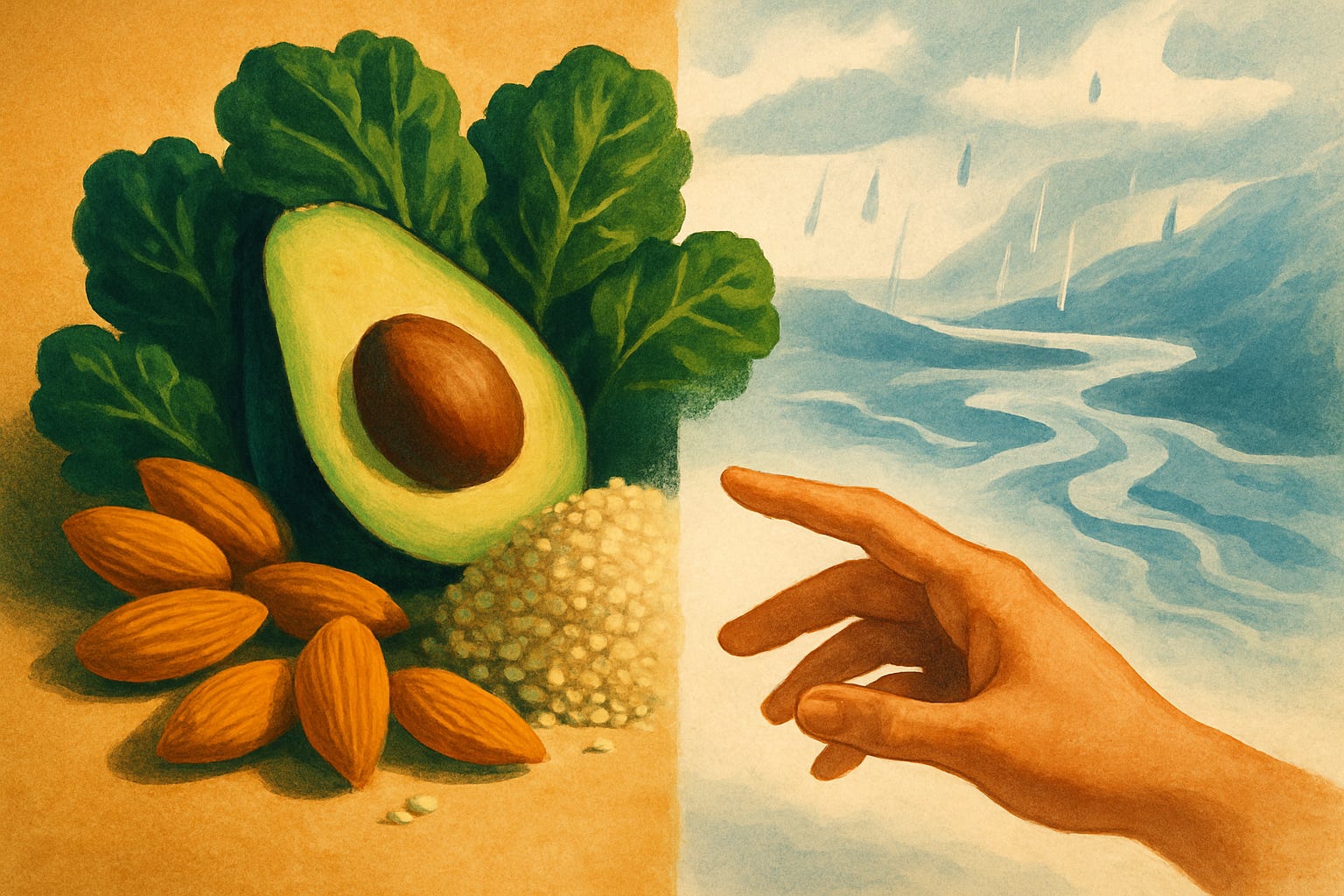
You did everything right. You swapped soda for smoothies, dairy for almond milk, and beef for a quinoa bowl topped with avocado. Your doctor is thrilled. But your grocery cart might be doing more environmental damage than the diet it replaced. 🥑 That is not a guilt trip, it is just physics: growing food takes land, water, and energy, and some of the healthiest foods on the planet happen to be some of the thirstiest and most land-hungry.
None of this means you need to panic-quit avocado toast. It means the “healthy equals green” assumption deserves a second look. Here are six foods worth rethinking, and what to actually do about it once you know the numbers.
The water hogs: almonds and avocados
Almond milk built its whole brand around being the planet-friendly choice. It has a lower carbon footprint than dairy, that part is true. But the water math tells a messier story. Growing a single almond takes roughly 1.1 gallons of water, and California, which is prone to drought, grows more than 80% of the world’s supply. Multiply that by a glass of almond milk every morning and the water bill adds up fast. 💧
Avocados have a similar problem, just with a land twist. According to the World Avocado Organisation, a kilogram of avocados carries an average water footprint of about 800 liters, and Mexico supplies roughly 80% of the avocados eaten in the US. The bigger issue, though, is what avocado farms are replacing. Illegal orchard expansion has driven serious deforestation in Michoacán and Jalisco, which is why the industry only just committed to deforestation-free exports by 2026. 🌲
Neither food is remotely as bad as beef, to be clear. But here is a question worth sitting with: how often do you actually check where your almonds or avocados were grown, versus just grabbing the bag?
Almonds: roughly 1.1 gallons of water per nut, concentrated in a drought-prone region
Avocados: about 800 liters of water per kilogram, plus documented deforestation ties
Both still beat beef and lamb by a wide margin on carbon
The fix is portion and sourcing, not elimination
Quinoa’s complicated superfood story
Quinoa is the poster child for this whole problem, and it is a genuinely uncomfortable one. When the West discovered quinoa’s protein and fiber profile, global demand exploded, and prices in Bolivia’s Altiplano region jumped as much as 1,500% between the early 2000s and 2014. Farmers got richer. Then the intensive farming that made that possible started degrading the very soil the crop depends on. 🌾
A 2026 report from Mongabay found that decades of monoculture quinoa farming, combined with a hotter, drier climate, have left Bolivian growers dealing with eroded soil and shrinking yields in the same fields that once fed the boom. Add in the human cost: at the height of the price surge, local consumption of quinoa in Bolivia dropped by nearly a third because the grain that fed generations of families had become too expensive for them to eat.
That does not mean quinoa is off the table. It means the story is more layered than a nutrition label lets on, and I think that is worth knowing before you toss it in every single bowl out of habit.
Farmed shrimp and the mangrove problem nobody talks about
Shrimp gets marketed as a lean, low-calorie protein, and nutritionally, sure. Environmentally, farmed shrimp might be one of the worst offenders on this entire list, and almost nobody clocks it. 🦐 Between 1980 and 2012, roughly a fifth of the world’s mangrove forests were cleared to make room for shrimp ponds, according to a United Nations report. That matters enormously, because mangroves store carbon far more efficiently than most tropical rainforest, some estimates put it at several times the rate per acre.
The World Economic Forum has flagged shrimp as a genuine test case for whether the global food system can decouple growth from habitat destruction, and a few exporting countries are proving it is possible. But most farmed shrimp on US grocery shelves still is not there yet.
About 90% of shrimp eaten in the US is imported, adding shipping emissions on top of farming impact
Roughly a fifth of the world’s mangroves have been lost to shrimp pond expansion since 1980
Mangroves sequester carbon at a rate that outpaces most land-based forests
Look for certified sustainable or domestic shrimp when you can
Dark chocolate and the produce that flew farther than you did
Dark chocolate gets a health halo for its antioxidants, and it earns it, mostly. But it is also one of the highest-emitting plant-based foods by weight, largely because of deforestation tied to cocoa farming and the dairy blended into most bars. One kilogram of chocolate produces somewhere around 19 kilograms of greenhouse gases, putting it uncomfortably close to some meats on a per-weight basis. 🍫
Then there is the quieter offender: out-of-season produce. That bag of asparagus in December, or the strawberries in February, probably traveled a long way to reach your cart, often by air freight, which is brutally carbon-intensive. One estimate puts a pound of out-of-season asparagus at nearly 20 pounds of CO2 emissions, most of it from transportation alone, putting it ahead of chicken and eggs on the impact scale. ✈️ I will admit this one surprised me the first time I read it. A vegetable beating out chicken on emissions feels backwards until you remember it flew here.
What to actually do with this information
None of these six foods deserve to be exiled from your kitchen. The point is not purity, it is awareness, and a few small shifts do most of the heavy lifting. I covered the ten foods with the single biggest carbon footprint if you want the full ranked list, and for budget-friendly swaps, these sustainable food hacks are a solid starting point.
A few practical moves that actually help:
Buy produce in season and locally when you can, skipping the air-freight tax
Choose oat or soy milk over almond milk if water scarcity concerns you more than land use
Look for shrimp with a sustainability certification, or eat it less often
Treat dark chocolate and avocado as things you enjoy, not things you eat daily by default
Remember that reducing red meat still matters more than any swap on this list, according to the UN’s food and climate research
So here is the real question: of the six foods above, which one is already sitting in your fridge right now? That is probably the one worth rethinking first.