

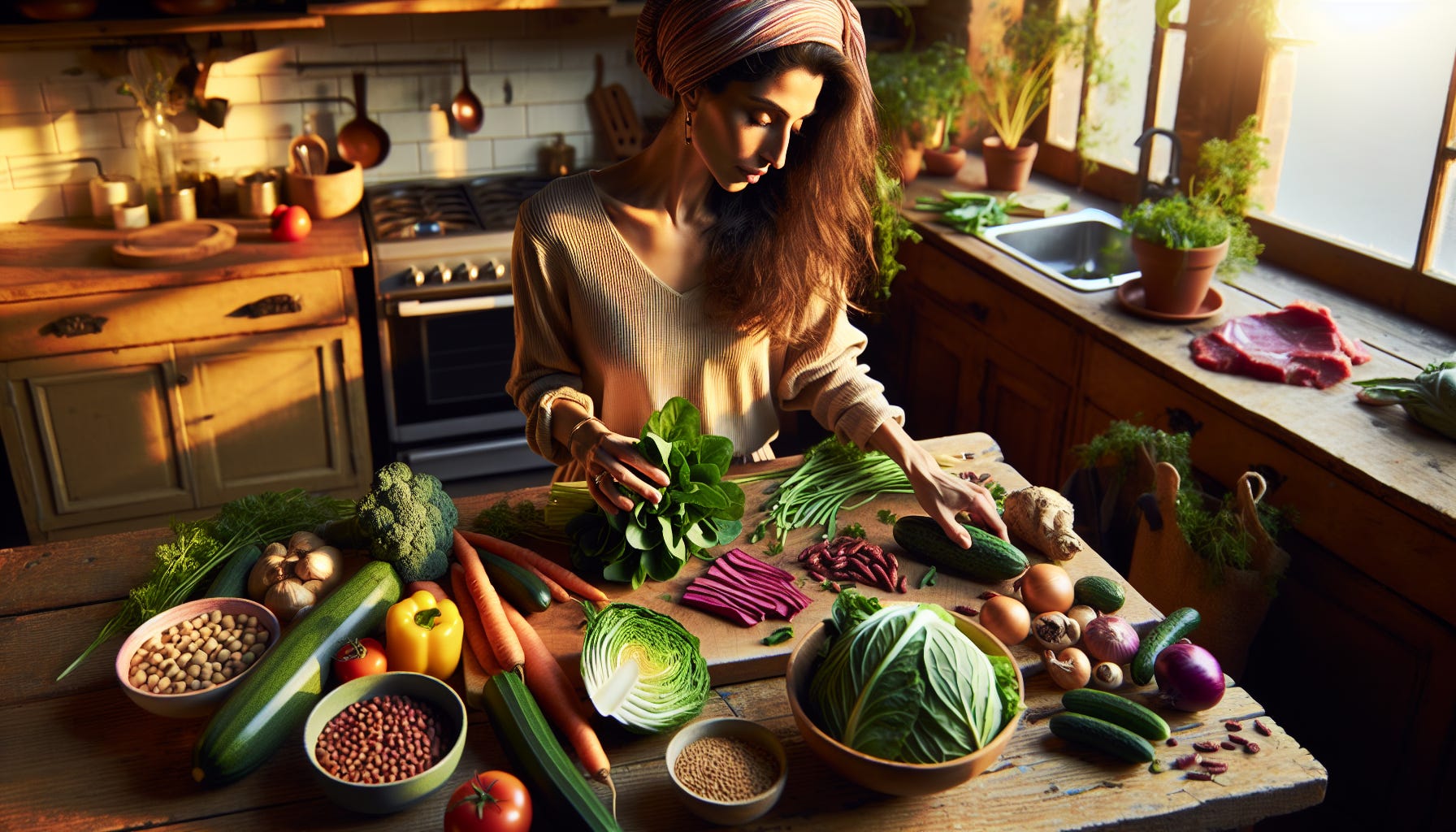
Your dinner plate has a carbon footprint. That’s not a guilt trip — it’s just physics. Every kilogram of food you buy carries with it the emissions from the land that grew it, the animals that produced it, the fuel that transported it, and (often) the forests that were leveled to make room for it. Food production generates around a quarter of all global greenhouse gas emissions, which makes what you eat one of the most powerful environmental levers you have access to. More powerful, it turns out, than whether you drive an EV, fly less, or religiously sort your recycling.
Here’s the thing that surprises most people: what you eat is far more important than where your food came from. Transport typically accounts for less than 1% of beef’s greenhouse gas emissions. All that hand-wringing about air-freighted asparagus? Probably misplaced. The real action is in what’s on your fork, not how far it traveled to get there.
So let’s look at the actual numbers — the foods that are quietly making our collective climate problem much worse, and the swaps that can genuinely move the needle.
The top offenders: meat that costs the planet dearly
🥩 The headline figure here is brutal. Beef emits an astounding 99 kilograms of CO2-equivalents per kilogram of the final meat product — though most analyses, including the landmark Poore and Nemecek study published in Science, put the figure at around 60 kg CO2e per kg across different production systems. Either way, nothing else is close.
Why so bad? Three reasons stack on top of each other:
Land conversion: Forests get cleared to create cattle pasture, releasing stored carbon all at once
Enteric fermentation: Cows burp methane as they digest, and methane has a warming potential 27–30 times higher than CO2 over a 100-year period
Feed crops: Growing the grain and soy that feeds cattle uses enormous amounts of fertilizer and energy
🐑 Lamb and mutton come in second, at around 24 kg CO2e per kg — still catastrophically high compared to almost anything plant-based. Sheep emit methane too, and they need a lot of land per kilogram of meat produced.
🐷 Pork sits at roughly 7–12 kg CO2e per kg, and poultry at 6–10 kg CO2e per kg. These are significantly lower than beef and lamb, though still higher than most plant-based foods. If you’re a committed meat-eater and want to make a real dent in your footprint without going fully plant-based, switching from beef to chicken is genuinely one of the highest-impact single diet changes you can make.
What to eat instead: Lentils, chickpeas, black beans. They clock in at under 1 kg CO2e per kg and deliver comparable protein. Tofu and tempeh are also strong performers — both land at around 2–3 kg CO2e, which is practically nothing compared to what’s above.
Cheese and dairy: the numbers that shock cheese lovers
🧀 Cheese doesn’t get the same bad press as beef, which I think is a mistake. A kilogram of cheese can reach up to 21 kg CO2e — higher than pork, and not far behind lamb. The reason is straightforward: it takes roughly 10 liters of milk to make 1 kilogram of cheese, and all the emissions from those dairy cows stack up fast.
Butter is similarly hefty. Cow’s milk itself is lower at around 3 kg CO2e per liter, but the sheer volume consumed globally makes dairy a major contributor overall. Dairy and meat together account for 83% of diet-related emissions across EU countries — which puts things in perspective pretty quickly.
A few things to know about dairy’s footprint:
Hard cheeses (parmesan, cheddar) require more milk per kg and thus carry heavier emissions than soft cheeses
Butter’s footprint rivals hard cheese because it’s almost pure fat extracted from cream, requiring huge milk volumes
Greek yogurt uses more milk than regular yogurt, so it sits higher on the emissions scale too
What to eat instead: A glass of oat or pea milk carries about 71 grams of CO2e — more than four times lower than cow’s milk. Nutritional yeast replaces the savory depth of parmesan in cooking surprisingly well. For butter, good-quality olive oil handles most culinary tasks and has a dramatically smaller footprint.
Have you checked the labels on your plant-based milks lately? Some use more water or land than others — oat tends to win on overall environmental metrics, though your mileage may vary depending on where you live.
Farmed shrimp: the ocean food with a land problem
🦐 This one genuinely blindsides people. Shrimp feels like a light, sustainable choice — small creature, no land, minimal processing. The reality is almost the opposite. Shrimp produce 12 kg of greenhouse gas emissions per kilogram produced, with over two-thirds occurring during the farming phase.
The culprit isn’t the shrimp itself — it’s where the farms go. Coastal mangrove forests are destroyed to build shrimp farms, releasing the enormous stores of carbon locked in those ecosystems. Mangroves are among the most carbon-dense habitats on Earth. When you bulldoze one to build a shrimp pond, you’re releasing carbon that was sequestered over decades, all at once.
The scale of this is difficult to overstate. It’s estimated that a 100-gram shrimp cocktail could carry a carbon footprint equivalent to burning 90 liters of gasoline. That’s for a starter.
What to eat instead: Clams, oysters, and mussels are the standouts here — they actually improve water quality as they filter-feed, and their emissions are a fraction of farmed shrimp. Wild-caught, sustainably certified fish is another strong option.
Dark chocolate and coffee: the plant-based surprise
🍫 Chocolate’s reputation as a plant-based food makes people assume it’s fine. It’s mostly fine, but dark chocolate specifically earns its place on this list. One kilogram of chocolate produces approximately 19 kg of greenhouse gases, making it one of the highest-emitting plant-based foods by weight. Most of dark chocolate’s emissions come from land-use changes — deforestation that alters the balance of greenhouse gas emissions and reduces the Earth’s ability to absorb CO2.
The Ivory Coast has destroyed 90% of its forests in 60 years, with cocoa farming cited as the primary cause of deforestation in West Africa. That’s a staggering statistic for something most people eat casually as a snack.
☕ Coffee has a similar story. Unsustainable coffee production involves clearing diverse forest to plant monoculture farms. The good news: certifications exist to identify coffee sourced from unchanged land and produced with fair wages for farmers — look for Rainforest Alliance or Bird Friendly labels, which are genuinely meaningful rather than greenwashed.
What to eat instead: You don’t have to give up chocolate or coffee — I’d never suggest that. But choosing certified sustainable versions (look for Rainforest Alliance or Fairtrade on cocoa) and reducing portion sizes does matter. For chocolate specifically, milk chocolate actually has a lower footprint per bar than dark chocolate because it contains less cocoa per gram.
Rice, palm oil, and the foods hiding in plain sight
🌾 Rice feeds more than half the world’s population, which is precisely why its climate impact matters so much in aggregate. Rice grows in flooded fields, and the standing water prevents oxygen from penetrating the soil, allowing bacteria underground to produce methane. Globally, rice cultivation generates a significant slice of agricultural methane emissions.
Individual footprint: around 2.7 kg CO2e per kg of rice — not catastrophic by itself, but enormous when multiplied by the billions of servings eaten daily. Some more sustainable farming techniques exist, including intermittent flooding (draining the paddies periodically to interrupt methane production), but adoption is slow.
🫒 Palm oil is a different kind of problem. Palm oil produces 7.60 kg of greenhouse gas emissions per kilogram, with the majority coming from land-use change and plantation farming. It hides in an extraordinary range of products — pizza dough, lipstick, instant noodles, chocolate, detergent — which makes it hard to avoid without reading every ingredient label carefully.
The situation is genuinely complicated. Palm actually has a higher oil yield per hectare than other vegetable oils, which means replacing it completely could require even more land. Certified sustainable palm oil (RSPO-certified) is the realistic middle ground — imperfect but meaningfully better than uncertified sources.
Here’s what you can look at on your next grocery run to reduce footprint quietly:
Swap white rice for lentils or quinoa as your grain base a few times a week
Choose products with RSPO-certified palm oil rather than avoiding palm oil entirely (the replacement oils may be worse)
Check snack packaging for palm oil and opt for brands that disclose their sourcing
If you’re curious about reducing your footprint beyond food, the GreenInch guide on eco-friendly shopping covers how to read certifications and labels without losing your mind in the grocery aisle. And if you’re tackling your home’s broader footprint too, there are some solid ideas in how to be more green and sustainable at home.
The big picture: what actually moves the needle 🌍
A vegan diet has the lowest carbon footprint at just 1.5 tonnes CO2e per year, compared to a meat-heavy diet at 3.3 tonnes. That’s a meaningful gap — but going fully vegan isn’t the only path worth considering.
Research from Oxford University’s Joseph Poore shows that the single biggest lever for most people in wealthy countries is simply reducing beef and lamb consumption. Not eliminating. Reducing. You can cut your food carbon footprint by a quarter just by cutting back on red meats like beef and lamb.
Here’s a practical hierarchy of swaps, roughly ranked by impact:
🥩 Cut beef first — nothing else delivers comparable emissions savings per meal
🐑 Reduce lamb — nearly as impactful as beef on a per-kg basis
🧀 Eat less hard cheese — counterintuitive but genuinely significant
🦐 Swap farmed shrimp for mussels or clams — dramatic improvement with almost no taste sacrifice
☕ Choose certified sustainable chocolate and coffee — lower impact but worth doing
The point isn’t perfection. It’s recognizing that what you eat matters enormously — more than buying local, more than avoiding plastic straws, more than the carbon offset you might tack onto a flight. Food is a daily decision. That also makes it a daily opportunity.
What’s the one swap on this list you’d be most willing to try this week? Drop it in the comments — I’m genuinely curious whether the shrimp revelation or the cheese numbers hit harder.