

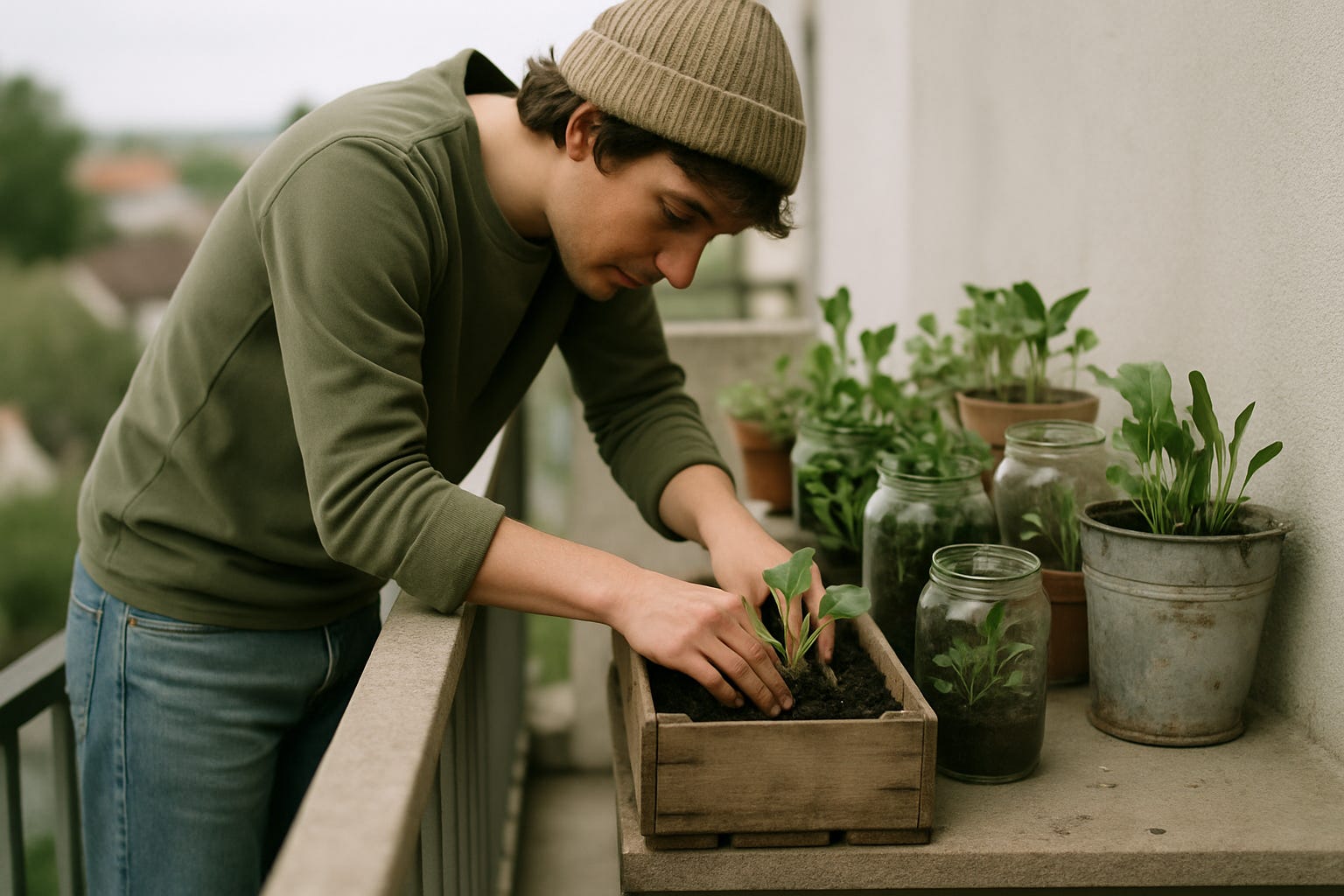
You don’t need a backyard. You don’t need a budget. You barely need a plan. What you need is a balcony with a few hours of daily sun and the willingness to treat your kitchen scraps as a starter kit rather than trash. Right now, sitting in your recycling bin or on your countertop, there is probably everything you need to start growing real food.
The idea that growing vegetables requires expensive raised beds, bags of premium soil, and a collection of tools from the garden center is mostly a myth sold by garden centers. A 2025 report cited by National Mortgage Professional found that American garden sizes have been shrinking for years, which means more of us are working with exactly the kind of modest outdoor space where this guide applies. Small balconies. Big ambitions. Tiny seed budget, ideally zero.
Here’s how to grow six genuinely useful vegetables on a balcony for almost nothing, using containers you already own, soil you can make yourself, and seeds you can source from your own grocery haul.
The containers you already have
Before you spend a single euro or dollar, look around your home. Almost every experienced zero-cost gardener will tell you the same thing: the best planter is the one you were about to throw away.
Sharon Yiesla, Plant Knowledge Specialist at The Morton Arboretum, put it plainly: “Just about anything that you can poke drainage holes in and won’t decay quickly can be a container.” She has seen boots, lunch boxes, old wagons, and wicker baskets used successfully. The real list of what works is essentially everything that holds soil without dissolving in a season. 🌱
Good free container candidates from around your home include:
Large plastic bottles (2-litre and 5-litre) cut horizontally and given drainage holes with a heated skewer
Wooden crates from greengrocers, often given away free if you ask nicely
Old colanders and metal pots with natural drainage already built in
Fabric shopping bags — these actually work brilliantly for root vegetables because the fabric air-prunes roots
Yogurt tubs and takeaway containers for starting seeds before transplanting
The one rule that matters: drainage. Without holes in the base, your plants will drown in the first heavy rain. Punch or drill at least three holes in the bottom of any container. If you can’t make holes in a particular item, nest a drilled plastic pot inside it and leave a gap at the base. 💧
If you need the bigger picture on doing more with less indoors and outdoors, Greeninch has a solid piece on making your apartment eco-friendly without touching a single lease clause.
Free soil and fertiliser from your kitchen scraps
Here’s the part most people skip, and it’s where the real savings are. Commercial potting mix is expensive. A decent bag costs between €8 and €20 depending on where you live, and you’ll need several for a full balcony setup. The good news: you probably produce enough raw material to cut that cost significantly or eliminate it entirely.
Balcony composting is simpler than it sounds, and it doesn’t smell when you do it right. The easiest method for a small space is vermicomposting, which just means a bucket with worms in it. Set up a plastic container with drainage holes near the bottom and air holes near the top, add a layer of shredded newspaper, drop in some red wiggler worms (available cheap from fishing shops), and start feeding it your vegetable peelings, coffee grounds, and tea leaves. According to Balcony Boss, the key ratio to aim for is roughly 60% “green” organic matter (food waste, plant trimmings) to 40% “brown” matter (cardboard, newspaper, dry leaves). Too much green material and the bin gets wet and smelly. Add cardboard and it dries out nicely. ♻️
A second route: according to the EPA’s composting guidance, keeping a small container on your countertop for daily scraps makes the whole habit frictionless. Empty it into your main bin every couple of days.
What you can compost for free:
Vegetable and fruit peelings (almost anything)
Coffee grounds and paper filters
Tea leaves and paper teabags
Eggshells (add calcium, slow to break down but worth it)
Shredded cardboard packaging
What to skip: meat, dairy, cooked food with oil, and citrus in large quantities.
Your worm castings, once ready in about 6 to 8 weeks, are extraordinarily rich fertiliser. Mix them into free or cheap soil, or top-dress your pots every few weeks. Also worth doing: save your pasta water, vegetable cooking water (unsalted), and aquarium water if you have fish. All of these carry dissolved nutrients and plants lap them up.
The 6 vegetables — and how to get the seeds for free
This is where it gets satisfying. For five of these six vegetables, you can source your starting material from the supermarket. 🌿
1. Green onions (scallions)
These are the easiest, most rewarding, and most immediately useful thing you can grow. Buy a bunch from the supermarket, use the green tops in your cooking, then plant the white root ends in any container at least 15cm deep. Within a week you’ll have new growth. Within two weeks you can harvest again. Repeat indefinitely. One bunch from the shop becomes a permanent, self-regenerating supply. Container size: small, any 15cm-deep pot will do. Sunlight: 4 to 6 hours daily.
2. Lettuce
According to seasonal growing expert Sarah Raven, leafy greens make the perfect cut-and-come-again crops — even in winter, you can keep harvesting from the same container by the kitchen door. Buy a living lettuce from a supermarket (the kind sold with roots still attached, often for under £1), plant it into a container with good drainage, and it will keep producing for weeks. For seeds, let one plant go to flower and seed at the end of the season — you’ll have hundreds of seeds for next year, for nothing. Container size: 10 to 15cm deep, wide. Sunlight: 4 hours minimum.
3. Radishes
Radishes grow from seed to harvest in 25 to 30 days, which makes them the instant-gratification win of balcony gardening. The seeds are tiny, cheap (usually under €1 for a packet containing hundreds), and because you can sow a small batch every two weeks, you get a continuous supply rather than a glut. They need almost no depth — 10cm is enough — making them perfect for shallow containers. If you grow them alongside slower crops like carrots, they use the space efficiently while the carrots are still developing. Sunlight: 5 to 6 hours daily.
4. Cherry tomatoes
Yes, tomatoes work on a balcony, but you have to pick the right variety. Full-size beefsteak tomatoes in pots are a commitment that often ends in disappointment. Cherry tomatoes in compact varieties like ‘Balcony’ or ‘Tiny Tim’ are a completely different proposition. They stay small, produce continuously from midsummer through autumn, and genuinely thrive in containers of at least 5 litres. For seeds: scrape them from a store-bought cherry tomato onto a paper towel, let them dry for a week, and you have dozens of free seeds. They need 6 to 8 hours of sun, a stake or small trellis (even a long bamboo skewer works), and consistent watering. Don’t let the soil dry out completely between waterings. Sunlight: 6 to 8 hours daily. 🍅
5. Kale
Kale’s reputation as a bit of a food trend cliché doesn’t change the fact that it’s extraordinarily productive in a small container. A single plant keeps producing leaves from the outside in for months, right through autumn and into the first frosts. It tolerates partial shade better than most vegetables, making it a good choice for east or west-facing balconies that don’t get full afternoon sun. Buy a small kale plant from a garden centre or supermarket herbs section in spring, plant it in a 25 to 30cm deep container, and harvest outer leaves as you need them. The plant keeps pushing out new growth from the centre. Sunlight: 4 to 6 hours daily.
6. Garlic
This one requires the most patience — around 7 to 9 months from planting to harvest — but the effort is almost zero. Break a head of supermarket garlic into individual cloves, plant them pointed-side up about 5cm deep in any pot that’s at least 20cm deep, and leave them to it. In spring, before the bulbs are ready, you get garlic scapes: the curling green shoots that you cut off to redirect energy into the bulb. Scapes are genuinely delicious stir-fried or stirred into pasta. Then in early summer, the bulbs are ready. One head of garlic becomes several heads. The cost: the price of one head of supermarket garlic. Sunlight: 6 hours daily.
Have you tried regrowing any of these from kitchen scraps before? Drop a comment — it’s genuinely interesting to compare notes on which ones surprise people most.
Placement, watering, and the vertical dimension
A few practical things that make the difference between a balcony full of struggling plants and one that actually produces food. 🌞
Sunlight is non-negotiable. Before you commit to growing anything, spend a day observing your balcony. Note when direct sun hits each section and for how long. A south-facing balcony in the northern hemisphere with 6+ hours of sun can grow almost anything on this list. A north-facing one is trickier — stick to lettuce, kale, radishes, and green onions, which all tolerate partial shade.
Watering in containers is the thing most beginners get wrong in both directions. Pots dry out much faster than ground soil, especially small ones in full sun. In summer, most containers need watering once a day, sometimes twice for very small pots. At the same time, overwatering — keeping soil saturated rather than just moist — kills more container plants than drought does. The test: push your finger 2 to 3cm into the soil. If it’s still moist there, wait. If it’s dry, water thoroughly until it drains from the bottom.
Vertical space is your friend. Most balconies have far more vertical surface than floor space, and Greeninch’s guide to smart garden ideas for zero-yard-space households covers this well. Rail planters hook directly onto balcony railings. Repurposed wooden pallets mounted on a wall become a multi-tier planter in an afternoon. Even a simple shelf bracket with three small pots gives you three times the growing area without taking up floor space.
Key vertical and space-saving approaches:
Railing planters for lettuce, herbs, and radishes along the entire balcony edge
A bamboo or string trellis for cherry tomatoes to climb rather than sprawl
Stacked crates or shelves for tiered growing at different heights
Hanging fabric planters for trailing or shallow-rooted crops
Pest management on a balcony is usually minimal, but watch for aphids on tomatoes and kale. A spray bottle filled with water and a few drops of dish soap handles most infestations without any cost. Companion planting helps too: green onions near tomatoes repel certain pests naturally.
The honest cost breakdown
Let’s be real about what “almost zero cost” actually means in practice, because it varies. 🌍
If you start from scratch with nothing:
Containers: €0 if you use found and repurposed items, as described above
Soil: €0 to €15 depending on how much you make vs. buy. A small bag of general-purpose compost costs about €5 to €8 and will stretch across several containers when mixed with homemade compost
Seeds: €0 to €5. Lettuce, green onions, garlic, and cherry tomatoes can all be sourced from supermarket produce. Radish seeds cost about €1 for a packet that lasts years. Kale seeds or a starter plant costs €1 to €2
Fertiliser: €0 if you compost, as above
Tools: a watering can (or repurposed bottle), a fork (or a stick), your hands
A realistic first-season setup costs between €5 and €20 if you source containers wisely and make your own compost. Compare that to what a weekly supermarket run costs for the same vegetables, and the break-even point arrives within a few harvests.
The RHS (Royal Horticultural Society) research on container growing consistently shows that compact varieties specifically bred or selected for pots outperform standard varieties by a significant margin, so spending €1 or €2 extra on the right seed variety (like a named compact cherry tomato) pays back fast.
One thing worth flagging: if your balcony gets very hot in midsummer — which is increasingly common in southern and central European cities — you may need to water twice daily and consider lighter-coloured containers that don’t absorb heat. Dark pots can get so hot they cook roots. This is the one genuine variable that can shift the difficulty from easy to moderate, and it’s worth thinking through before you start.
What would make you more likely to try balcony growing — better knowledge of which varieties to pick, or knowing exactly where to source free containers?
One last thing about why this matters
Growing even a small amount of your own food is not just a money-saver, though the savings are real. According to the EPA, food waste accounts for around 30% of US municipal waste, and a significant chunk of that is produce that spoilt before it was eaten. When food is growing on your balcony two metres from your kitchen, you harvest what you need and nothing goes to waste. The supply chain from soil to plate is literally a short walk.
There’s also something the Greeninch piece on sustainable food habits captures well: eating more sustainably doesn’t require grand gestures or expensive substitutions. It often just requires doing something slightly unusual with a supermarket garlic bulb and a spare yogurt container. The balcony garden is, at its most modest, a handful of pots and some kitchen scraps. At its best, it’s the start of a habit that cuts your food bill, cuts your waste, and produces things that taste noticeably better than anything you can buy. ♻️🌱
Start with one container. Green onion roots in a yogurt tub on a sunny windowsill. Once you see them grow, the rest tends to follow on its own — so which of these six vegetables are you planting first?