

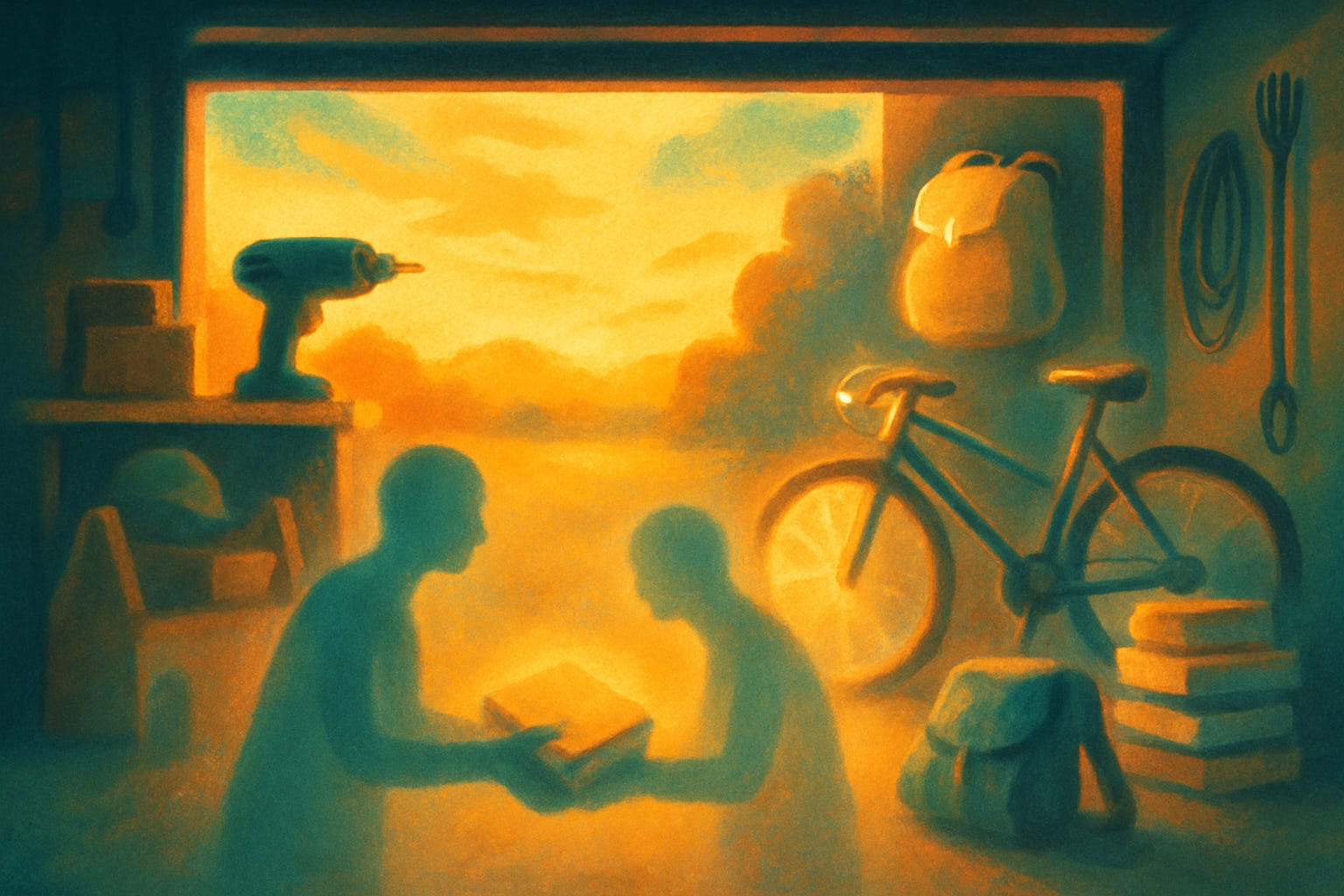
Open your garage right now. Go ahead, I will wait. Somewhere in there is a pressure washer used twice, a tent that has seen one camping trip, and probably a power drill that has drilled a grand total of maybe a dozen holes in its entire life. 🔧 You paid full price for all of it, and it is doing nothing but taking up space and slowly losing value.
The sharing economy, the broad idea of borrowing, renting, and swapping instead of buying new, has grown into a $244.8 billion global market as of 2025, and it is expected to climb toward $310 billion in 2026. That is not just Uber and Airbnb anymore. It is your neighborhood tool library, your local Buy Nothing group, and the car-share app parked two blocks away. Here is why leaning into it actually moves the needle, both for your bank account and for the planet.
The $500 drill you will use twice
You have probably heard the stat: the average power drill gets used for somewhere between 12 and 15 minutes over its entire lifetime. I love this stat, and I also have to be honest with you, nobody has ever actually tracked down the original study behind it. Writers have been repeating it since a 2010 TED talk with no real source in sight, and Fast Company eventually called out the whole industry for citing it as gospel. 😅
That said, the underlying point survives the fact-check. Tool libraries exist precisely because most specialty tools sit idle nearly all the time, and that part is not in dispute. A shared tile saw, pressure washer, or wood chipper serves dozens of households instead of gathering dust in one garage. Here is what a decent tool library setup actually replaces:
The pressure washer you use once a year to clean the driveway
The tile saw for that one bathroom renovation
The camping gear that only comes out for a single trip
The specialty baking pans you bought for one birthday cake
The ladder tall enough for gutters, useless for anything else
Fewer of these get manufactured, fewer end up in a landfill, and your closet gets some space back. Everybody wins except the big-box hardware store, and honestly, I am fine with that.
Buy Nothing groups: the neighborhood you did not know you needed
Somewhere around 2013, the Buy Nothing Project started as a single Facebook group on an island in Washington state. It is now a global network of hyperlocal groups where people give away, and ask for, literally anything: half a bag of flour, a crib nobody needs anymore, a lawnmower, a ride to the airport. No money changes hands. 🎁
The environmental case is simple. Every item someone hands off instead of throwing out is one less thing pulled from a landfill, and one less new item manufactured to replace it. The social case might be the more surprising part. These groups tend to turn strangers into actual neighbors, the kind who wave at you now and maybe water your plants when you travel. I think that piece gets undersold in most write-ups, honestly, because it is the part that makes people stick around after the free couch phase wears off.
Search Facebook or Buy Nothing Project’s app for a group tied to your specific neighborhood
Post what you are getting rid of before you default to the trash can
Ask before you buy, you might be surprised what someone is offering for free
Expect a slower pace than a marketplace app, this is a community, not a store
The car sharing math that actually holds up
Unlike the drill stat, this one has real research behind it. Multiple studies, including a 2022 impact report on car sharing in Belgium and academic work compiled by the Shared-Use Mobility Center, land in a consistent range: one shared vehicle replaces somewhere between 9 and 13 private cars, with some US city estimates running even higher. 🚗 Fewer cars manufactured, fewer cars parked, less asphalt needed for parking lots that sit empty most of the day.
The carbon math backs it up too. Drivers who give up private car ownership entirely after switching to car sharing cut their personal transportation carbon footprint by roughly 40%, according to peer-reviewed research on the topic. You are not just saving on gas and insurance, though you are definitely doing that. You are opting out of an entire manufacturing and disposal cycle every time you choose not to own a second car that mostly sits in a driveway.
Your closet does not need to be a landfill donor
Clothing swaps are not new. Suzanne Agasi started hosting them in San Francisco back in 1994 and has run more than 300 events since, well before “sustainable fashion” was a marketing phrase anyone used. What has changed is the scale: the global secondhand apparel market is now projected to hit $367 billion by 2029, and nearly half of younger shoppers say they check secondhand options before buying new. 👗
I already wrote a full beginner’s guide to thrift shopping if you want the tactical version of this, plus a broader rundown of shopping habits that meaningfully cut your footprint. The short version here: a closet swap with five friends does the same job as a shopping trip, minus the receipt and the guilt.
How to actually start this week
None of this requires a lifestyle overhaul. Pick one category, start small, and let habit do the rest.
Search for a tool library or “library of things” in your city before your next home project
Join your local Buy Nothing group and post one item you no longer need
Try a car-share app for your next one-off trip instead of renting or buying
Host or attend one clothing swap before your next seasonal wardrobe refresh
Which one of these is already sitting half-used in your house right now? Pick that one first. It is probably the easiest place to start, and someone nearby probably needs exactly what you are done with.