

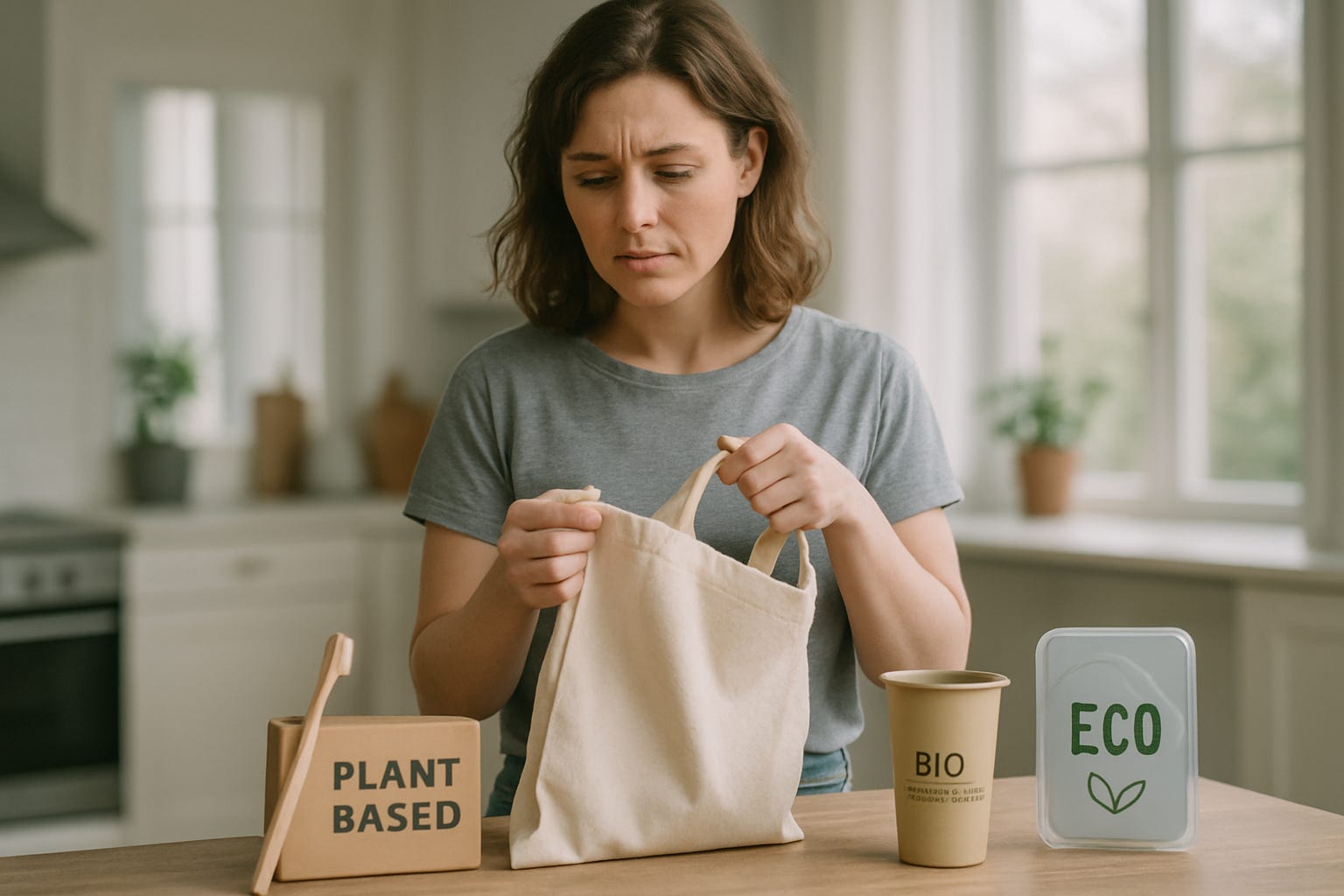
You’re a good person. You carry a canvas tote. You buy the bamboo toothbrush. You reach for the bottle that says “plant-based” without reading the fine print, because honestly, who has time? The green aisle of your grocery store looks like a nature documentary, all leaves and earthy tones and soothing fonts that whisper trust me.
Here’s the uncomfortable truth: some of the products most associated with eco-conscious living have dirty secrets buried in their supply chains, chemistry, or disposal realities. That’s not a reason to give up — it’s a reason to get smarter. Let’s go through five of the worst offenders, because the Environmental Working Group has been saying for years that vague green claims often collapse the moment you actually examine them.
The cotton tote bag
This one genuinely hurts to write, because the cotton tote has become the universal symbol of caring about the planet. It’s on every sustainable brand’s merch table. It’s in every reusable-product roundup. And according to a landmark 2018 Danish Environmental Protection Agency life cycle assessment, a conventional cotton tote must be used at least 7,100 times to offset its environmental footprint compared to a standard single-use plastic bag. 🌱
That number isn’t a typo. Seven thousand one hundred uses. If you shopped every single day, that’s nearly 20 years of daily use before your tote breaks even on climate impact alone.
Why so many? Cotton is a resource monster:
It requires enormous quantities of water, fertilizer, and pesticides to grow
Manufacturing generates roughly 271 kilograms of CO2 equivalent per bag, versus about 1.6 kg for a plastic bag
Cotton totes are difficult to recycle in most U.S. cities — only 15.2% of all textiles were recycled as recently as 2017
Organic cotton, paradoxically, fares worse — the Danish study found it needs 20,000 uses because of the additional land it requires
This doesn’t mean plastic bags are fine — they’re not, for obvious ocean-and-landfill reasons. But the cotton tote isn’t the slam-dunk solution it’s sold as. The more honest choice? A recycled polypropylene bag from a thrift store or made of post-consumer plastic, which breaks even with single-use plastic after just 10–15 uses. Or, even simpler: use the bags you already own, whatever they’re made of, until they fall apart. That’s the actual eco move.
Have you ever counted how many tote bags you own? Most people I know have a dozen stuffed in a drawer, including me — and that’s precisely the problem.
Bamboo products (especially fabric and “composite” items)
Bamboo is a genuinely remarkable plant. It grows fast, sequesters carbon, requires no pesticides in its wild state, and doesn’t need replanting after harvest. So far, so good. 🎋
The problem is everything that happens after it gets harvested — particularly when it becomes fabric.
Most bamboo fabric on the market is not bamboo fabric. It’s rayon or viscose that was once bamboo. The plant is dissolved in harsh chemical solvents, extruded into fibers, and washed. The process is energy-intensive, those solvents are rarely recovered in a closed loop, and the resulting product has about as much connection to a bamboo grove as a plastic bottle does to an oil well. The U.S. Federal Trade Commission has fined multiple companies for falsely labeling rayon as “bamboo fabric.”
For bamboo tissue and paper products, a 2025 North Carolina State University study found that bamboo tissue made in China — where roughly 70% of the world’s bamboo is processed — had a larger environmental impact than North American wood-based tissue in several categories. The culprit is China’s coal-heavy electricity grid, which powers bamboo processing plants. The bamboo itself is fine; the factory running on coal is not.
Watch out for these bamboo product red flags:
“Bamboo fabric” with no mention of production process or OEKO-TEX certification
Bamboo plastic composite cups, which are often labeled eco-friendly but can’t be composted or recycled
Any bamboo product shipped long distances from Asia without a credible carbon offset
Items that just say “natural” on the label without specifying what that means
Solid bamboo products — flooring, furniture, cutting boards — are a genuinely different story. When locally sourced or properly certified, they can be legitimately low-impact. The material isn’t the villain; the processing is.
Biodegradable and “compostable” plastics
The word “compostable” on a cup or fork implies a happy ending: you toss it, nature takes it back, everyone wins. The reality is so different it should probably require a disclaimer in bold. 🗑️
According to EPA 2024 data, nearly 90% of biodegradable plastics in the U.S. end up in landfills, not compost facilities. Once in a landfill — which is sealed, compacted, and largely oxygen-free — most biodegradable plastics don’t biodegrade in any meaningful timeframe. Research published in the Journal of Waste Management in 2025 found that in landfill conditions, some of these materials may take up to 200 years to break down, which is no better than conventional plastic.
Making it worse:
“Compostable” legally refers to industrial composting at high temperatures and controlled humidity — not your backyard pile, which almost never gets hot enough
The Composting Council of America reported in 2025 that only 15% of U.S. households have access to curbside composting
Beyond Plastics, the NGO, found in 2024 that compostable bioplastics often produce more greenhouse gas emissions over their lifetime than single-use plastic, partly due to emissions from the agricultural phase of making plant-based feedstocks
When incinerated (as happens to much U.S. waste), these plastics release methane — a greenhouse gas far more potent than CO2
The Beyond Plastics organization has been pushing back hard on the compostable-equals-sustainable claim, and they’re right to do it. Labeling packaging “biodegradable” without specifying the conditions and timeframe required is classified as deceptive under FTC Green Guides.
What actually works? Refusing single-use items entirely where you can. Bringing your own containers. Choosing certified home-compostable packaging, which is labeled differently from industrial compostable and actually breaks down in a backyard pile. The bar is much higher and the labels much rarer — but that’s the point.
“Natural” and plant-based cleaning products
This category might be the most insidious, because the harm is invisible. 🌿 You buy a lavender-scented “plant-powered” cleaner, feel virtuous, spray it around the kitchen — and potentially make your indoor air quality worse than if you’d used a conventional cleaner.
A 2024 University of York study published in Environmental Science: Processes & Impact compared 10 regular cleaners with 13 green ones and found that the eco-friendly products released more monoterpenes — a category of volatile organic compounds — than their conventional counterparts. Researcher Ellen Harding-Smith stated directly that “many consumers are being misled by the marketing of these products.” The EPA notes that VOC concentrations can be up to 10 times higher indoors than outdoors after using scented products.
The problem is the fragrance. Both synthetic and “natural” fragrances — pine oil, citrus terpenes, lavender essential oils — release VOCs when they hit room-temperature air. And because manufacturers aren’t required to disclose what’s in “fragrance” as an ingredient, a product can be marketed as plant-based while hiding a cocktail of chemicals behind that one word.
Here’s what to actually look for instead of the word “natural”:
EPA Safer Choice certification — every ingredient is individually evaluated against human health and environmental criteria
EWG Verified status, which requires full ingredient disclosure
Fragrance-free formulas, which eliminate the terpene problem almost entirely
The USDA Certified Biobased label, which at least confirms renewable ingredients
The EPA’s Safer Choice program is the most reliable filter I know of. A green bottle and some leaves on the label mean nothing without it. And if you genuinely love the GreenInch approach of detoxing your cleaning routine without losing the sparkle, that article goes deeper on specific swaps that actually hold up.
Electric vehicles — but only if you’re not paying attention
Wait, wait. Don’t close the tab. ⚡ EVs are not on this list because they’re bad overall — they’re here because the way people talk about them is often misleading, and it matters.
The honest picture, per a 2025 PLoS Climate study from Northern Arizona University and Duke University, is this: when a new EV rolls off the assembly line, its carbon emissions are roughly 30% higher than an equivalent gas car. Battery production, primarily the mining of lithium, cobalt, and nickel, is massively energy-intensive. According to an MIT Climate Lab report, mining one ton of lithium releases nearly 15 tons of CO2. The brine extraction process used for much of the world’s lithium supply consumes hundreds of millions of gallons of fresh water per year in some of the driest places on Earth — including the Atacama Desert in Chile, where lithium mining consumes up to 65% of the region’s water.
The deeper problem is where the batteries come from. China processes nearly two-thirds of the world’s lithium and about 75% of cobalt. Its electricity grid still gets roughly 60% of its power from coal. So an “emissions-free” EV battery may have been built in a factory running on the dirtiest possible fuel.
Here’s what redeems the EV — and this part is important:
After approximately 2 years of driving, cumulative EV emissions fall below those of a gas car
Over an 18-year vehicle lifetime, gas cars cause 2–3.5 times more environmental damage than EVs
If you charge from solar panels, the math improves dramatically (GreenInch’s guide to eco-friendly home upgrades that pay for themselves covers exactly this)
The point isn’t that EVs are bad. The point is that buying a new EV every 4 years to chase the latest range improvements is absolutely not green. The most sustainable choice is to drive whatever you own — gas or electric — into the ground, then replace it with the most efficient option that fits your actual life. And if you’re weighing an EV purchase right now, GreenInch’s no-nonsense EV guide is the most honest starting point I’ve found.
So what does this mean for your shopping cart?
None of this means sustainability is a scam. It means marketing is not a substitute for supply chain transparency, and “green” on a label is legally meaningless without certification to back it up.
The three principles that actually hold up under scrutiny:
Buy less. The most sustainable product is almost always the one you already own and use until it’s genuinely finished.
Look for third-party certification, not self-declared labels. EPA Safer Choice, OEKO-TEX, EWG Verified, and FSC are the ones worth trusting.
Ask about end-of-life. A product that can’t be composted, recycled, or reused in your actual city isn’t a green product — it’s a greenwashed one.
The companies caught greenwashing in 2025 — Shein received a €1 million fine from Italian regulators for exactly this kind of thing — aren’t outliers. They’re an indicator of how normal it’s become to sell a story instead of a solution.
What’s the product you’ve bought believing it was eco-friendly that you’re now second-guessing? I’d genuinely like to know — because I’m still finding things in my own house that don’t hold up when I look closely enough.