

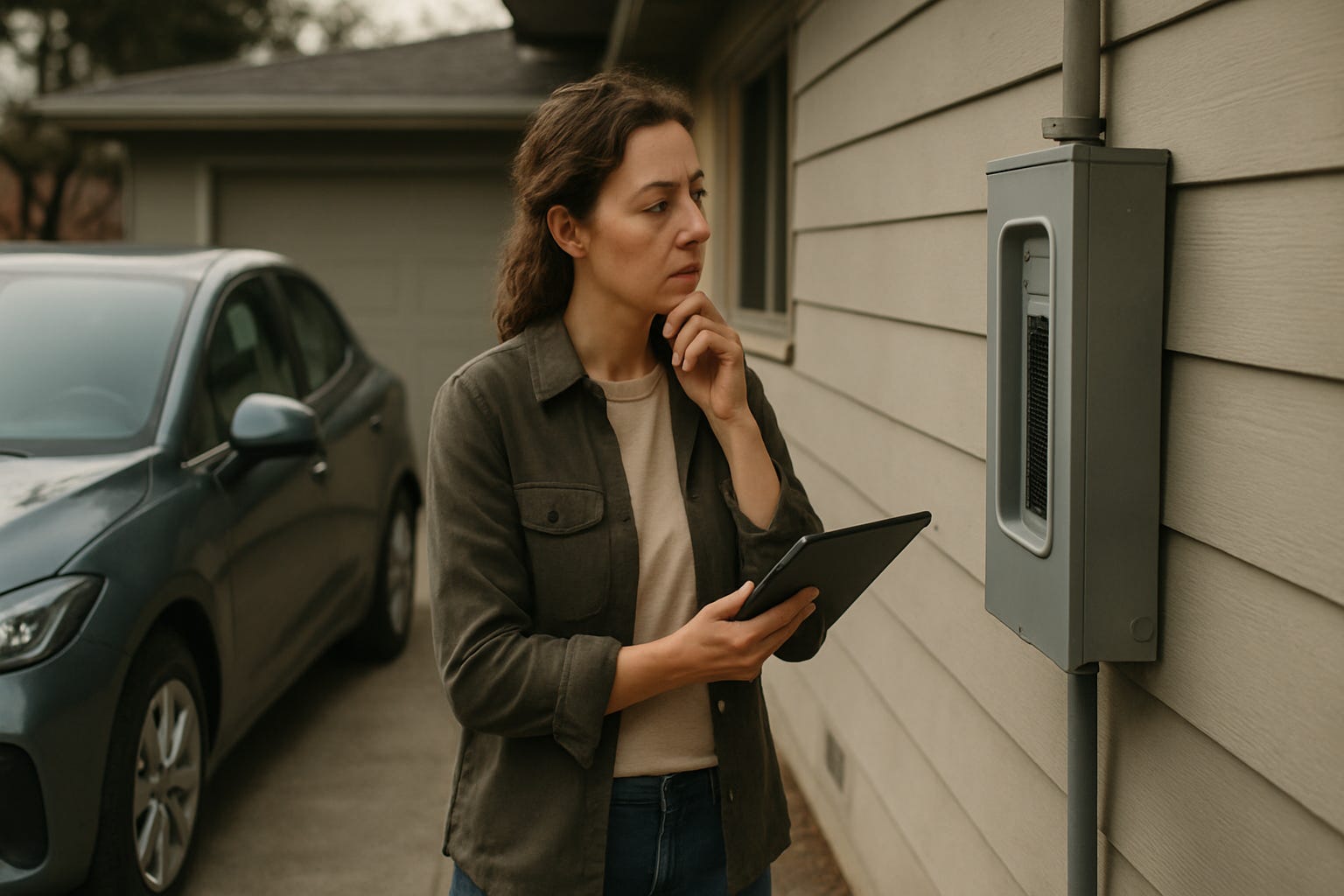
Picture this: you’re standing in a dealership parking lot, keys to a shiny new electric vehicle in your hand, trying to remember if your home’s electrical panel can handle the charger you haven’t bought yet. Nobody warned you about the panel. Nobody warned you about the insurance either. And the salesperson is already talking about the cupholder options.
Electric vehicles are, genuinely, one of the most exciting green choices a family can make right now. 🌱 They cut tailpipe emissions to zero, cost a fraction of a gas car to run, and — this is the part that converts skeptics fast — driving one is really fun. The instant torque is a genuine thrill. The silence is meditative. Waking up to a “full tank” every single morning is a small luxury that quickly feels indispensable.
But EVs are not magic. They come with trade-offs, surprises, and a few myths that the automotive marketing machine has been spectacularly useless at clearing up. Whether you’re seriously shopping or just curious, this is the guide you actually need — the one that treats you like an adult.
The range anxiety myth (and what actually matters)
Let’s get this out of the way first, because it’s the question that stops more people from buying an EV than any other: what if I run out of charge? 🔋
The honest answer is that you almost certainly won’t. According to research cited by the Department of Energy, the average American drives fewer than 40 miles a day. The median EPA-rated range for a new EV sold in model year 2024 was about 283 miles per charge — more than four times what it was in 2011, according to data tracked by Recharged. Even a “budget” EV sitting in the 220-260 mile range covers a week of typical commuting between charges.
Here’s what does matter, though:
Real-world range is always lower than the EPA sticker. Cold weather, highway speeds above 70 mph, cargo weight, and aggressive heating all shrink your usable range. A car rated at 300 miles in a test lab might deliver 240 miles on an icy Tuesday with the heat on full blast.
The 80% rule changes everything. Most EV experts recommend keeping your battery between 20% and 80% for daily use to preserve long-term health. That means a 350-mile rated vehicle effectively becomes a 210-230 mile vehicle in everyday life. Factor that in.
Public charging is genuinely getting better, but “better” isn’t “perfect.” The US now has over 156,000 public charging ports across nearly 60,000 locations, per SolarTech Online’s 2025 analysis. Still, reliability varies wildly by network and location.
The psychological reality is interesting too. Less than 8% of EV drivers have ever actually run out of charge, according to data compiled by SolarTech. Range anxiety is mostly a pre-purchase phenomenon — it tends to dissolve within weeks of ownership, once you’ve built a routine. 😌
The question worth asking yourself isn’t “what’s the maximum range I could ever need?” It’s “does this car cover my actual week, comfortably, with a buffer?” If the answer is yes, range isn’t your problem. What do you think your daily driving reality actually looks like?
Home charging: what it really costs
This is the section that gets glossed over in almost every EV review — and it’s the one that genuinely catches people off guard. 🏠
Here’s the baseline: you can charge an EV from a regular 120V household outlet (called Level 1 charging). It adds roughly 3-5 miles of range per hour. That’s painfully slow — think overnight charging for the equivalent of a short errand. For most owners, it’s simply not practical as a daily solution.
What you almost certainly want is a Level 2 home charger — a 240V unit (same type of circuit as your dryer or oven) that adds 20-40 miles of range per hour and fully charges most EVs overnight. According to Recharged’s 2025 cost analysis, most U.S. homeowners spend roughly $1,200 to $3,000 all-in for equipment and installation, before incentives.
That spread exists because your number depends heavily on:
How close your electrical panel is to where the car parks
Whether your panel has capacity (older homes often don’t — an upgrade adds $1,300 to $3,500)
Your local labor rates (California and New York tend to run higher)
Whether you need outdoor weatherproofing or long conduit runs
The good news: the federal 30C tax credit covers 30% of equipment and installation costs, up to $1,000. Many utilities stack their own rebates on top of that. With incentives, a standard install often ends up costing $800-$1,500 out of pocket.
Once it’s in, the math gets genuinely satisfying. Charging at home typically costs one-third of what you’d pay at a public DC fast charger. For a 60 kWh battery, a full home charge runs roughly $7 to $15 at average U.S. electricity rates of $0.12-$0.25/kWh. Set your charger to run on off-peak time-of-use rates, and that number drops further.
The charger install is an upfront cost, not an ongoing one. Budget for it separately from the car itself, get three quotes from licensed electricians, and don’t let anyone talk you into skipping permits. An improperly wired 240V circuit behind drywall is not a risk worth taking.
If you rent, or park on the street, things get more complicated — and honestly, that’s a real limitation worth weighing seriously before you commit.
The battery question everyone’s afraid to ask
“What happens when the battery dies?” It’s the question that makes EV skeptics feel vindicated and EV enthusiasts roll their eyes. The truth is somewhere between the horror stories and the dismissiveness. 🔬
Battery replacement costs in 2025 run from $5,000 to $20,000, depending on pack size and brand, according to Recharged’s battery cost guide. Some large trucks and luxury EVs can exceed $25,000 once you add labor and taxes. Those numbers are real, and they’re legitimately significant.
But here’s the context that almost never makes it into the conversation:
According to research firm Recurrent Auto, only 1.5% of EVs have ever needed battery replacement — and that drops to just 0.5% in models built after 2016.
Modern EV batteries degrade at roughly 1.8-2.3% per year under normal use, per Motorwatt’s analysis of recent fleet data.
Almost every current EV sold in the US carries an 8-year/100,000-mile warranty against excessive battery degradation. Most owners sell or trade before the pack becomes a serious issue.
Goldman Sachs projects battery pack costs will reach $80/kWh by 2026, meaning replacement costs are actively falling.
The behaviors that genuinely accelerate degradation are worth knowing:
Relying heavily on DC fast charging above 100 kW (Geotab’s 2025 analysis of 22,700 EVs found this can double degradation rate)
Regularly storing at 100% charge for extended periods
Parking in extreme heat without shade or climate control
Be kind to the battery and it will be kind to you. Keep daily charging between 20% and 80%, use fast chargers as a road-trip tool rather than a daily habit, and the battery anxiety recedes dramatically. 😊
For used EV buyers, insist on a battery health report. It’s the EV equivalent of a pre-purchase inspection, and any seller who refuses to provide one is answering a different question entirely.
Hidden costs nobody puts in the brochure
The average transaction price for a new EV was $59,255 in April 2025, per Autoblog’s ownership cost analysis — and that figure already includes an average 11.6% incentive discount built into the price before you arrive. So the sticker is misleading before you even start negotiating. 💸
Beyond the car itself, here’s what tends to surprise first-time owners:
Insurance runs higher. According to Bankrate, EV insurance premiums run 10-30% higher than comparable gas vehicles. LexisNexis determined in 2024 that EV claim frequency runs 17% higher overall — partly because EV repairs require specialized shops and parts that aren’t yet as widely available as ICE components.
Depreciation hits harder, for now. Autoblog’s analysis found EV owners absorb roughly $8,000 more in resale losses over five years compared to gas equivalents. The used EV market is maturing fast, but it’s not equal yet.
Road usage fees are spreading. As EV drivers skip the gas tax that funds road maintenance, more states are introducing annual EV registration surcharges. These range from token amounts to genuinely irritating ones depending on where you live.
Public charging on road trips is pricier than you think. Fast charging at a public DCFC station costs roughly three times what home charging does per mile.
None of these kill the financial case for an EV — especially if you’re coming from an expensive gas habit and qualify for incentives. The federal tax credit of $7,500 was available on qualifying new EVs through September 30, 2025, and state incentives vary widely. Run the total cost of ownership math for your specific situation — not the average, your situation — before you decide.
One more thing worth considering: if you already have solar panels (or you’re thinking about them — GreenInch’s guide to eco-friendly home upgrades that pay for themselves is a good starting point), the EV math gets substantially better. Charging from your own roof is as close to free transport as most of us will ever get. 🌍
When an EV makes sense (and when it might not)
Here’s the part that most EV advocates skip because it feels like admitting weakness: an EV isn’t automatically the right choice for everyone, right now. ⚡
An EV is probably a great fit if:
You own your home and can install a Level 2 charger
Your typical daily driving is well under 150 miles
You have predictable driving patterns, with most miles on familiar routes
You have another vehicle for occasional long road trips, or you’re comfortable planning charging stops
An EV is harder to justify right now if:
You rent and have no access to charging at home or work
Your regular driving involves frequent long-distance hauls or remote areas with thin charging coverage
You tow heavy loads regularly (range loss under towing load is significant)
Your budget is tight and the upfront premium genuinely strains you
The sustainability case for EVs is real and it matters. A well-chosen EV driven on average U.S. electricity produces significantly lower lifetime emissions than a comparable gas vehicle, even accounting for manufacturing. The Department of Energy’s Alternative Fuels Data Center tracks this by state, since cleaner grids mean cleaner EVs.
If you’re ready to dig into the home energy side of this decision, GreenInch’s 5-minute home energy audit guide is a smart companion read — because how efficiently your home uses power affects the real-world cost of running an EV more than most people realize. 🌱
Going electric isn’t a leap of faith. It’s a practical calculation. Do it with your real numbers, your real driving habits, and your real home situation — and it becomes a genuinely clear-headed decision, not a marketing-driven one.
So: what’s the single thing that’s been stopping you from seriously considering an EV? Because I’d bet the honest answer is one of the myths this article just addressed.