

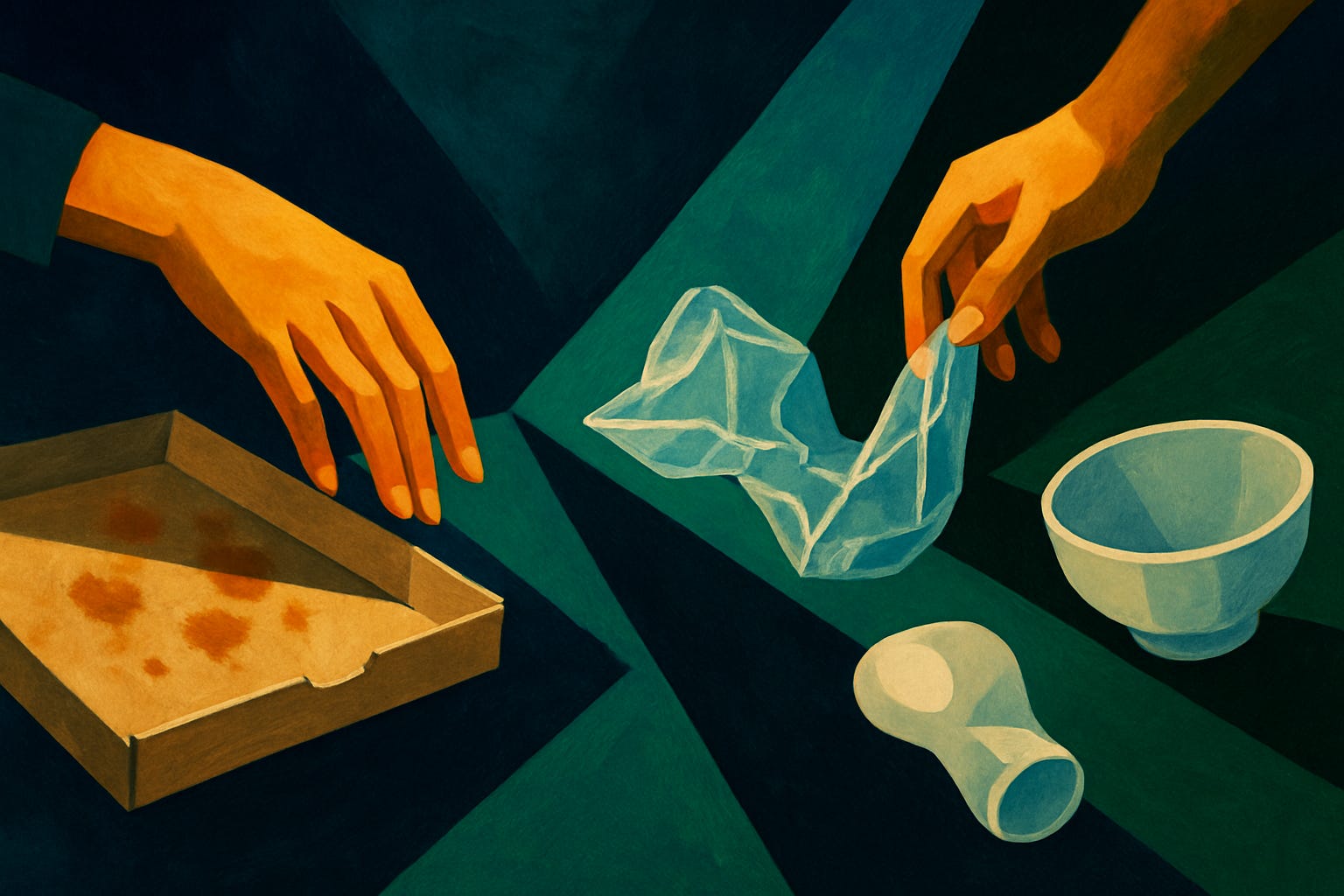
Here is an awkward fact about the blue bin. A lot of what goes in it is not recyclable, and the people tossing it in are usually trying their best. 🤦 A University of Florida study, reported by Resource Recycling, puts Florida’s contamination rate at 25 percent. In Lawrence, Kansas, a city audit found 16.2 percent, which the city describes as more than one item in every six being wrong or badly prepared.
We covered the general problem in our piece on common recycling mistakes. This one goes item by item. ♻️ Five things come up again and again, and I think at least two of them will surprise you.
Pizza boxes: the grease debate
Let’s start with the one that starts arguments at dinner parties. 🍕
The EPA says pizza boxes can be recycled, even with grease on them. Your local program might disagree. New York City sanitation officials told The New York Times, as Mental Floss reports, that a small grease spot is fine, but a box soaked through is not. Dallas goes further and asks for only the clean top of the box.
So what do you do? 🤔
Tear off the clean lid and put it in the bin
Put the greasy bottom in the compost if your city takes it, or in the trash
Never leave a slice or crust inside
Flatten the box first, because it saves space in the truck 🚚
The honest answer is that the rule changes by city, so check yours. What does your local program say about pizza boxes? I would genuinely like to know.
Plastic bags jam the machines
Plastic bags and film are the classic wishcycling example. 🛍️ They look like plastic, so in the bin they go.
The trouble is that sorting equipment is built for hard, rigid items. Bags, cords, and other “tanglers” wrap around the machinery and force workers to stop the line and cut them free. That is slow, costly, and sometimes dangerous. ⚠️
The EPA tells people to take bags and wrap to a store drop-off instead, and to cut the zipper off sandwich bags first. A simple rule of thumb: if it is soft and flimsy, it stays out of the curbside bin.
Grocery bags and bread bags go to a store drop-off
Bubble wrap and plastic film go to the same place 📦
Chip bags usually go in the trash
Better still, carry a reusable bag and skip the problem 🌱
The number on the bottom does not mean what you think
This one annoys me. 😤 You flip a container over, see the chasing arrows with a number inside, and assume the thing is recyclable.
It is not a promise. According to Wikipedia’s entry on resin identification codes, the code tells you which type of plastic you are holding and does not indicate whether a product is recyclable. The entry adds that people often misread the codes, and that this feeds wishcycling. Green Newton, a Massachusetts recycling group, puts it flatly: there are no magic numbers.
What works better is the shape of the item. 🔍
Bottles, jugs, and jars are accepted almost everywhere
Tubs, trays, and pots are hit and miss, so ask your hauler
Clamshells and clear takeout containers often fail
Styrofoam is not accepted in most curbside programs
A “recyclable” claim on the label does not override your local rules 🏷️
Batteries start fires
Now for the one with real danger attached. 🔥
Lithium-ion batteries power phones, laptops, vapes, and even singing greeting cards. When recycling equipment crushes one, it can ignite. An EPA analysis of battery fires in waste and recycling facilities counted roughly 245 fires between 2013 and 2020, and the agency notes that data is limited, so the true number is probably higher. Rumpke, a big Ohio hauler, reported another battery fire at one of its facilities in 2025 and says it cannot separate the batteries from the rest.
I find this the scariest item on the list, because one dead phone battery is small and easy to forget about in a drawer. 🪫
Never put any battery in the curbside bin, even a dead one
Take them to a store drop-off, since Home Depot, Best Buy, and Lowe’s run programs
Tape the terminals of loose batteries before you carry them 🔋
Check your county’s hazardous waste page for e-waste days
Bagged and dirty recycling
The last mistake is a pair. People bag their recycling, and people either skip the rinse or scrub every jar like a surgeon. 🧼
Start with the bag. Recology, a West Coast hauler, says bagged recycling can’t be processed and often goes straight to the landfill. A UK council puts it more bluntly: neither the bag nor what is inside gets recycled. So tip everything in loose.
On cleaning, a Colorado hauler offers a test I like. Leftover residue is fine, as long as there isn’t enough to bite or drink. A quick rinse beats a deep scrub, and it saves water. 💧
Keep recycling loose in the bin, never in a bag
Empty liquids, then give containers a quick rinse
Leave labels and staples on cardboard
Keep food-soaked paper, like napkins, out of the paper stream 🧻
So here is your next step. Open your city’s recycling page tonight, find the “do not recycle” list, and tape it inside your cabinet door. Which of these five mistakes were you making?