

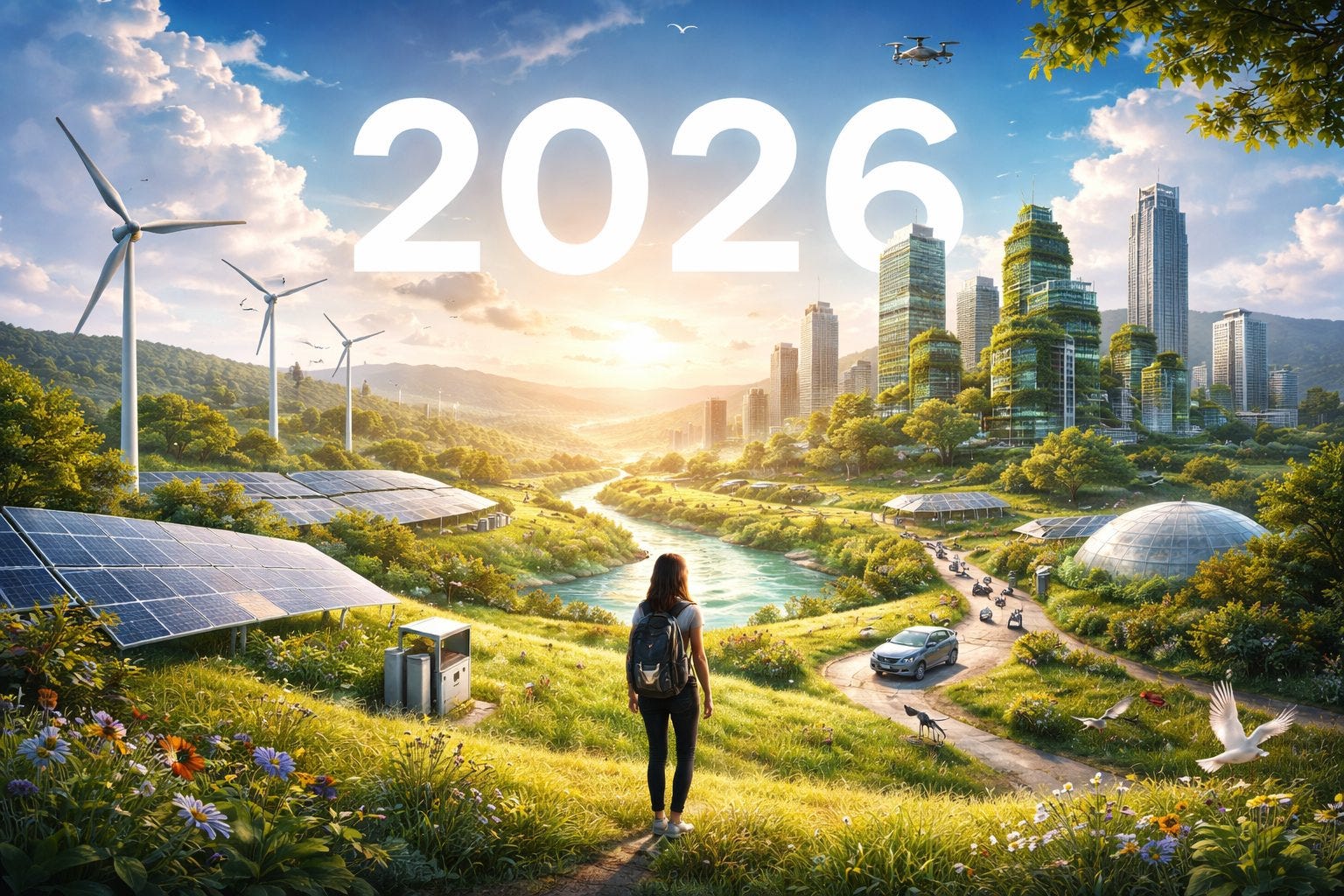
Sustainability in 2026 doesn’t feel polite anymore. It doesn’t knock. It shows up, rearranges the furniture, and asks why we’re still pretending this is optional.
I think something fundamental shifts. Sustainability stops being a branding exercise—no more leaf icons slapped onto plastic bottles—and starts behaving like infrastructure. Like Wi-Fi. Like electricity. You don’t market it. You assume it. Or you’re irrelevant.
This year, climate anxiety matures into climate pragmatism. Companies still talk values, sure, but now they also talk margins, regulations, supply chains, and risk. Consumers? They grow savvier, more impatient, and frankly less impressed. The planet doesn’t need promises. It needs systems that work. 🌱
So let’s talk about what sustainability actually looks like in 2026—beyond the buzzwords, past the greenwashing, and straight into the messy, fascinating middle.
From Green Promises to Measurable Proof 📊
If sustainability were a relationship, 2026 would be the “show me, don’t tell me” phase.
Vague pledges like “net zero by 2050” start sounding like “I’ll call you sometime.” Regulators, investors, and customers want receipts. Actual numbers. Audited data. Time-bound milestones. Carbon accounting tools evolve from niche software into boardroom essentials.
What’s different now is enforcement. Governments sharpen reporting rules. Financial institutions price climate risk directly into capital access. And ESG—once a fuzzy acronym—starts behaving like a spreadsheet with teeth.
At the same time, companies realize transparency isn’t just about compliance. It’s defensive. Brands that can’t prove their impact lose trust fast, probably faster than they expect. In 2026, sustainability reports aren’t glossy PDFs. They’re living dashboards. Real-time. Slightly terrifying. Completely necessary.
And yes, this probably makes some executives sweat. Good. Sweat is honest.
Circular Economy Goes From Theory to Muscle Memory 🔄
For years, the circular economy sounds lovely and abstract—like yoga for supply chains. In 2026, it becomes operational. Practical. Unavoidable.
Products are designed with their second, third, and fourth lives in mind. Repairability becomes a selling point, not an inconvenience. Companies stop asking “How do we sell more?” and start asking “How do we keep this in use longer?”
What’s driving this shift isn’t just environmental concern. It’s scarcity. Materials cost more. Supply chains break more often. Waste suddenly looks… expensive.
So brands respond creatively:
Modular designs that snap apart instead of break 🧩
Buy-back and resale programs that actually work
Subscription models replacing one-off ownership
Packaging designed to disappear, not linger
Consumers play along, mostly because it makes sense. And because tossing something “away” finally feels outdated. There is no away anymore. Everyone knows that.
Climate Tech Grows Up (And Gets Profitable) ⚙️
Clean tech in 2026 drops the scrappy startup hoodie and puts on a tailored jacket.
This isn’t about shiny prototypes anymore. It’s about scale. Climate software, energy storage, alternative proteins, carbon capture, and grid optimization mature into serious industries with real revenue, real customers, and real consequences.
What changes is the tone. Less “saving the world” rhetoric. More “this is cheaper, faster, and more resilient.” Sustainability stops arguing from morality and starts arguing from performance. And it wins that argument more often than not.
Investors notice. Governments partner up. Corporations acquire instead of experiment. Climate tech becomes boring in the best possible way. Reliable. Bankable. Normal.
And honestly? That’s when it sticks.
Sustainability Becomes a Talent Strategy 👩💼👨🔧
Here’s a quieter trend that matters more than it gets credit for: people choose employers based on sustainability credibility.
In 2026, employees—especially younger ones—read sustainability reports the way previous generations read salary bands. They want alignment. Not perfection, but honesty. Not slogans, but effort.
Companies respond by embedding sustainability into roles that have nothing to do with “green teams.” Finance, operations, HR, procurement—all of them own a piece of the puzzle. Sustainability isn’t a department. It’s a job requirement.
Training follows. Climate literacy becomes part of onboarding. Managers learn how emissions connect to decisions. Employees expect clarity, not spin.
And when companies fake it? Internal backlash hits faster than Twitter ever could.
Consumers Demand Less Noise, More Substance 🛒
The sustainable consumer of 2026 is tired. Not apathetic—tired.
They don’t want ten labels, three certifications, and a QR code that leads nowhere. They want simple signals. Clear trade-offs. Fewer claims. More honesty.
“I think this is better for the planet” beats “this will save the planet.” Humility works. Overpromising doesn’t.
Brands that succeed speak plainly. They admit limitations. They explain choices. They stop pretending sustainability is glamorous and start presenting it as what it is: responsible, sometimes inconvenient, but necessary.
And here’s the twist—this restraint builds more trust than hype ever did.
AI Quietly Reshapes Sustainability Decisions 🤖🌿
Yes, AI shows up here too. Of course it does.
But not in the flashy, headline-grabbing way. In 2026, AI hums in the background, optimizing energy use, predicting supply disruptions, reducing waste, and flagging inefficiencies humans miss.
The sustainability impact isn’t about chatbots writing climate poetry. It’s about models that:
Forecast emissions scenarios
Optimize logistics routes
Balance energy grids in real time
Reduce overproduction
The irony? AI itself raises sustainability questions—energy use, data centers, resource demand. That tension doesn’t disappear. It sharpens. And companies that acknowledge it, rather than dodge it, earn credibility.
What This All Means (And Why It Matters) 🌎
Sustainability in 2026 grows up. It stops asking for applause. It asks for accountability.
The biggest shift isn’t technological. It’s cultural. Sustainability becomes expected. Invisible when done right. Painfully obvious when ignored.
If you’re a founder, operator, investor, or policymaker, the message is simple:
You don’t need to be perfect. You do need to be real.
And if you’re a consumer? You already hold more power than you think. Your patience runs the market now.
So here’s the question worth sitting with:
👉 If sustainability stopped being a trend tomorrow, would your choices still make sense?
That answer tells you everything.