

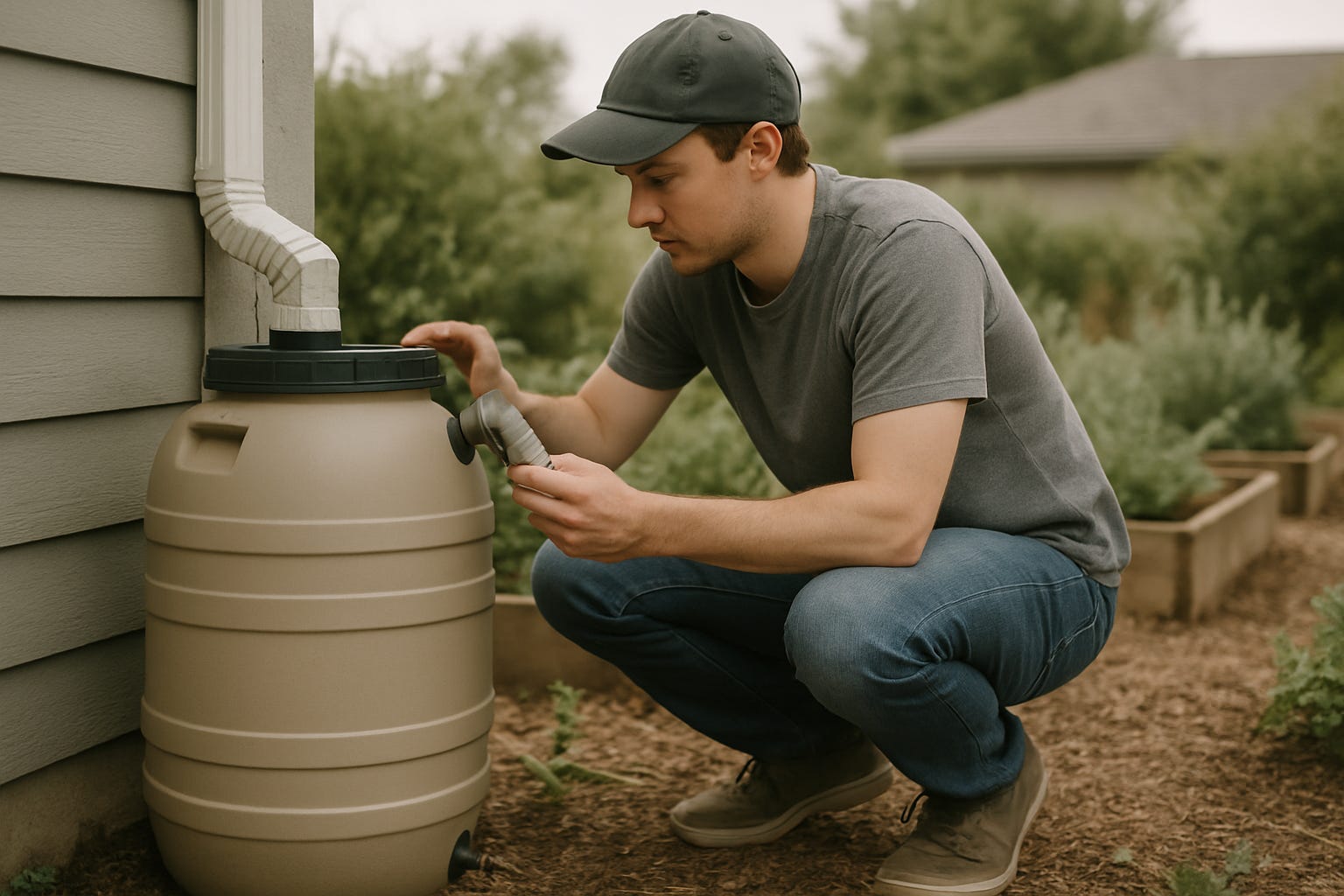
There is something quietly satisfying about intercepting rain before it disappears into a storm drain. You’re not doing anything radical. You’re just catching what falls on your roof, which has been happening since humans first figured out how to angle a thatched roof over a clay pot. The modern version costs around $40 in hardware, takes one Saturday afternoon, and produces something genuinely useful: free water for your garden all summer long.
I get it — “rain barrel” sounds like something your uncle built in 1987 out of a garbage can and good intentions. But a properly set-up rain harvesting system is clean, functional, mosquito-resistant, and, frankly, kind of elegant once it’s in place. According to the Southern Sustainability Institute, a single barrel can collect up to 1,300 gallons during peak summer months. That’s a lot of free watering. Let’s build one.
Why bother? The numbers make the case
Before we get into drills and downspouts, let’s talk about why this matters, because the case is stronger than most people realize. 🌧️
In cities, 90% of rainfall becomes runoff — it races across pavement, picks up oil, fertilizer, and chemical residue, and dumps all of that into storm drains and waterways. Your roof is part of that problem. When you collect that water instead, you’re pulling it out of the runoff cycle entirely, using it in your garden (where it soaks back into the groundwater), and reducing the load on municipal stormwater systems that are increasingly overwhelmed.
The numbers from a 2022 study published in PLOS ONE are striking:
Rainwater harvesting can cut non-potable household water use by 29–62%, depending on building and household size
In extreme storms, on-site rain capture can reduce peak flow to sewers by 57–67%
For garden irrigation and outdoor washing, around 80% of that water need can be met by rainfall alone in moderate climates
The financial side is real too. A basic rain barrel system can reduce your water bills by up to 40% over time, according to analysis by Thrive Lot. That payback period shrinks fast in drier states where water rates are higher. And rainwater, unlike tap water, contains no chlorine, no salts, and no fluoride — plants genuinely prefer it, and the difference is visible in the garden. 🌱
The other thing worth knowing: rainwater harvesting is legal in all 50 US states. The confusion persists, mostly from outdated stories about western water rights. As Rainplan’s 2026 state-by-state guide makes clear, 38 states have zero restrictions. Colorado caps residential collection at 110 gallons; Utah allows up to 2,500 gallons with registration. For a standard backyard barrel, you are unrestricted everywhere in the country. ✅
Before you go buy anything, do you already save water around the house in other ways? There are some great overlapping habits — GreenInch’s piece on 6 daily habits that help you save water without thinking about it is worth a read alongside this one.
What you actually need to buy
The beauty of this project is that nothing on the materials list is exotic. Everything comes from a hardware store, most of it from the plumbing and outdoor sections. Here’s what to grab:
A food-grade plastic barrel (50–55 gallons): Look for opaque, dark-colored barrels — they block sunlight and prevent algae. Check Facebook Marketplace, Craigslist, food processing businesses, or soda bottling companies. Many give them away free, rinsed from olive brine or syrup. If you buy new at a hardware store, expect to pay $20–$30.
A 3/4-inch brass hose bib (spigot): Spend the extra few dollars on brass rather than plastic. Plastic spigots crack after one freeze cycle. Brass lasts for years. Around $8–$10.
A bulkhead fitting (3/4-inch): This seals the spigot into the barrel wall without leaking. About $5–$7.
Fine fiberglass mesh screen: To cover the inlet opening and keep out mosquitoes. A small roll costs $4–$6.
Overflow hose or short PVC elbow: For directing overflow away from your foundation. Around $3–$5.
Waterproof silicone sealant: Under $5 at any hardware store.
4–6 cinder blocks: To elevate the barrel (more on why below). Often free, or about $2 each.
Grand total: $35–$50, depending on whether you can source a free barrel. Tools you’ll need — a drill, a hole saw bit sized to your spigot, and a hacksaw — are likely already in your garage. If not, borrow them; this is a one-afternoon job. 🔧
The EPA’s own rain barrel guide uses essentially this same parts list and has been circulated for years — reassuring proof this isn’t overengineered.
The build, step by step
Pick your downspout first. Walk around your house after rain and notice which gutter runs hardest. That one drains the most roof area, so it fills a barrel fastest. Level ground matters — a 55-gallon barrel full of water weighs around 460 lbs. If it tips, it tips hard. 🏗️
Step 1: Elevate the barrel
Stack cinder blocks or a pressure-treated wood frame to lift your barrel 12–24 inches off the ground. This is not optional. Gravity is your water pressure. At that height, you get roughly 10–15 PSI — not enough to wash a car, but plenty to fill a watering can, run a drip line, or feed a soaker hose without any pump at all.
Step 2: Install the spigot
Drill a hole 2–3 inches from the bottom of the barrel using a hole saw sized to your bulkhead fitting. Thread the bulkhead fitting through from the outside, add rubber washers on both sides, then thread your brass spigot into the bulkhead. Run a thin bead of waterproof silicone around the fitting on both the inside and outside faces. Let it cure for 24 hours before testing.
Step 3: Cut the inlet
Cut a 6–9 inch opening in the top of the barrel (or use the existing bung hole on a drum-style barrel). Cut a piece of fine fiberglass mesh screen several inches larger than the opening. Secure it over the hole with a tight-fitting lid, zip ties, or a metal ring clamp. This step is non-negotiable if you care about mosquitoes — any open, standing water in warm months becomes a larvae nursery within days.
Step 4: Add the overflow
Drill a 1.5–2 inch hole near the top of the barrel, on the opposite side from the spigot. Fit a short PVC elbow or overflow hose and direct it at least 5 feet away from your house’s foundation. Ignoring this step is the most common beginner mistake — a barrel filling faster than you draw from it will overflow right against your foundation, which is exactly where you don’t want standing water.
Step 5: Connect to the downspout
Cut the downspout about 6 inches above the barrel’s inlet height. A diverter kit (around $10–$15, optional but useful) channels water into the barrel when it’s not full and redirects overflow back down the original downspout automatically. Without one, just aim the cut downspout directly over the screened inlet. 🌿
Test the whole setup with a garden hose before the first rain. Open the spigot, check every seal, and look for drips. A small weep is fixable with a half-turn and a bit more silicone. A steady drip under pressure means the bulkhead needs retightening.
Maintenance that takes five minutes a season
A rain barrel is not a “set it and forget it” installation. But it comes close. Here’s the full maintenance calendar:
Spring startup: Rinse the barrel before first use, check the screen for debris buildup or tears, and inspect all fittings.
Mid-summer: If you see discoloration or a musty smell, drain and rinse. Algae can form in barrels that get direct sunlight — adding a dark sleeve or painting the barrel will fix this.
Fall shutdown (in freeze climates): Drain the barrel completely before the first hard frost, disconnect the downspout connection, and store the barrel upside down or in a shed. A barrel with water in it will crack in a hard freeze. No exceptions.
The Alabama Cooperative Extension System’s rain barrel guide recommends cleaning the barrel once a year with a mild solution of castile soap, lemon juice, and water if there are any odors from the barrel’s previous contents. That’s especially relevant if you sourced a used food barrel — even a “clean” pickle barrel will give your water an interesting character if you skip the rinse. 🫙
One more thing: label your barrel clearly as non-potable water. Collected rainwater is excellent for gardens, washing outdoor surfaces, and filling bird baths. It’s not safe to drink without serious filtration. This isn’t a scare — it’s just good practice to make the distinction obvious, especially if kids are involved.
Scaling up: what comes after one barrel
One barrel is a great start. Two barrels daisy-chained together is where this starts to feel genuinely impactful. ♻️
Run an overflow hose from barrel one’s overflow fitting into the inlet of barrel two. Simple as that. You’ve doubled your storage capacity to 100–110 gallons for roughly the cost of a second barrel. The first barrel fills, then the overflow feeds the second, and you draw from whichever is most convenient. Keep barrel one slightly higher than barrel two so gravity does the work.
From there, the sky — or rather, the roof — is the limit. A 275-gallon IBC tote (industrial bulk container) is the next step up for serious gardeners, costing $50–$80 used and capable of supplying a substantial vegetable garden through a dry summer. GreenInch has covered some of these larger-scale water conservation upgrades in its look at 5 green gadgets that instantly make your home more sustainable — smart irrigation controllers pair exceptionally well with a harvesting setup like this, because they won’t run your drip lines when the barrel is full or when rain is forecast.
Some homeowners eventually add a first-flush diverter — a device that catches the first few gallons of roof runoff (which carry the most dust, bird droppings, and residue) and discards them before allowing cleaner water into the storage barrel. For garden use, this is nice-to-have rather than essential. For any future greywater reuse, it becomes more important.
The point isn’t to build a perfect system this weekend. It’s to build a working system this weekend, see how quickly it fills, and let that satisfaction pull you toward the next upgrade. Most people who install one barrel find themselves installing a second within a season. The water is just there, and it’s free, and using it feels exactly like the kind of small, sensible thing that genuinely adds up. 💧
Have you already got a rain barrel, or is this your first time seriously considering one? Drop a comment — I’d genuinely like to know what’s holding people back, because the barriers are almost always smaller than they look from the outside.