

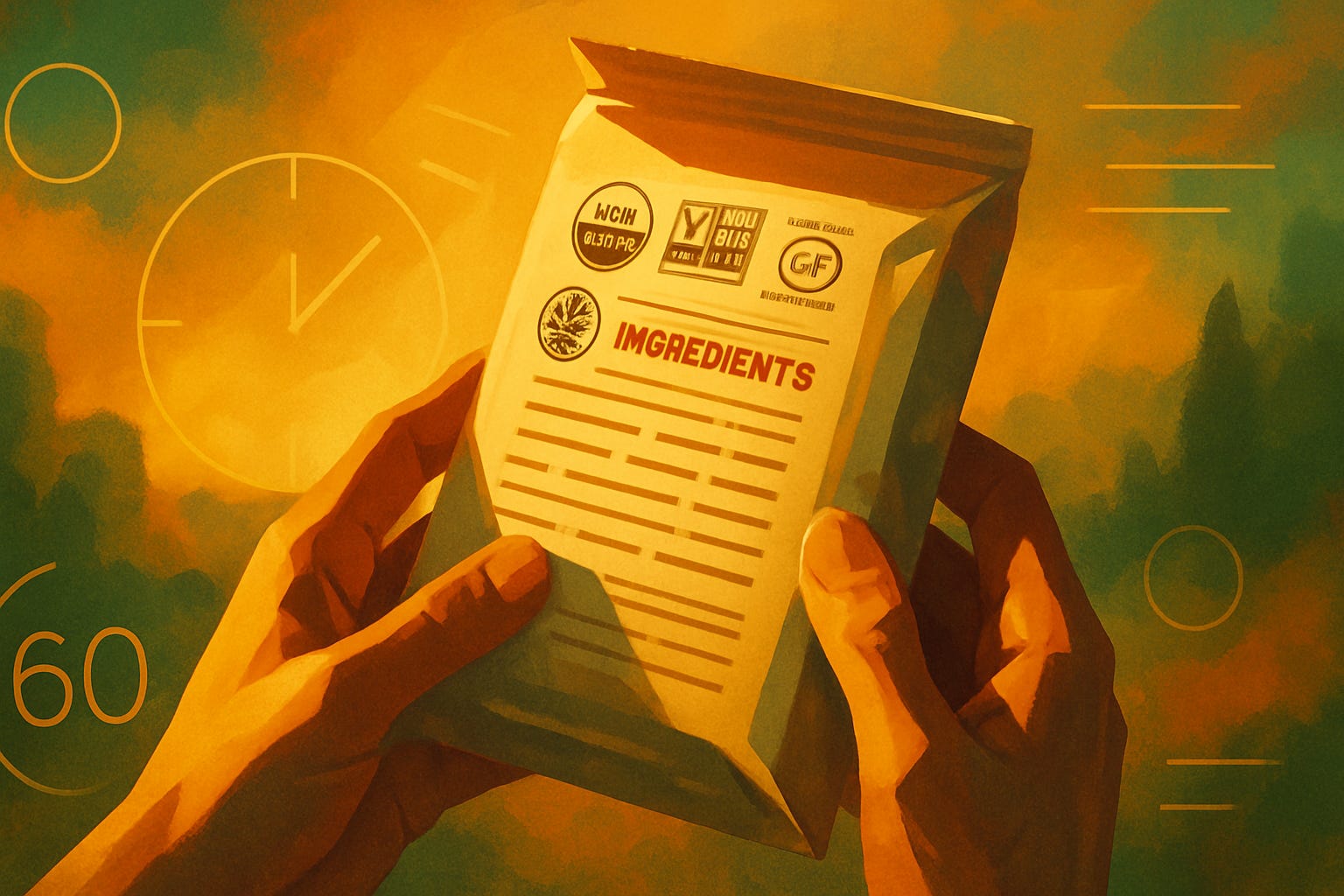
Pick up almost anything in your pantry right now and flip it over. The front of the box is doing a marketing job: green leaves, the word “natural,” maybe a farmer who’s never actually touched a tractor. 🌱 None of that is required by law, and most of it tells you nothing real about what the product cost to grow, ship, and package. The actual information lives in four specific spots, and once you know where they are, you can size up a box, a bag, or a can of tuna before your cart even stops rolling. 🛒 Here’s the order I go through, start to finish, in under a minute.
Skip the front, go straight to the seals
Words like “eco-friendly,” “sustainable,” and “conscious choice” have zero legal definition in the US, which means a company can print them on a bag of chips fried in the exact same oil as everything else on the shelf. 🏷️ Even natural, arguably the most trusted word on any label, isn’t regulated for food products either, so something loaded with high-fructose corn syrup and synthetic dyes can still wear it proudly. What actually means something is a third-party certification seal, because those require an outside auditor to check the claim before the logo goes on the box.
The ones worth trusting:
USDA Organic: verifies no synthetic pesticides or fertilizers were used
Rainforest Alliance: requires at least 90% of ingredients (or a disclosed percentage) to come from farms that protect forests, wildlife, and workers
FSC (Forest Stewardship Council): certifies the paper, cardboard, or wood-based packaging itself, not the food inside it
MSC blue fish tick: certifies wild-caught seafood from fisheries with enforced catch limits
If a claim doesn’t have a matching seal standing behind it, treat it as a guess, not a fact. I’ve written before about the specific greenwashing tricks brands use to dress up ordinary products, and the “where’s the seal” test catches nearly all of them in about two seconds. 🔍
Know what each seal actually promises (and skips)
Here’s where I get a little cranky, because seals aren’t interchangeable, and treating them that way is exactly how greenwashing sneaks back in through the side door. 🐟 Each certification protects one specific thing, not everything at once.
Take the Marine Stewardship Council. Its blue label means a fishery passed an independent audit covering stock health, ecosystem impact, and management, assessed across 28 separate performance indicators. That’s genuinely rigorous. ✅ But MSC certification doesn’t ban bottom trawling, a practice that drags a net across the seafloor and catches whatever happens to be in the way, which is why some marine biologists push back on trusting the label blindly. Rainforest Alliance has a similar asterisk: it protects forests, climate, and worker livelihoods, but it isn’t a fair trade certification and doesn’t guarantee pesticide-free farming.
Before you trust any seal, run this quick check:
Does it cover the ingredient, or only the packaging?
Does it address climate impact, or one narrow issue like deforestation?
Is it independently audited, or is it a company’s own in-house logo dressed up to look official?
Have you ever grabbed something just because of a leaf logo, no seal in sight? Be honest. 😅 It’s basically the entire packaged-food industry’s business model.
Read the ingredient list like you’re checking IDs
The ingredient list is where the real environmental cost hides, because it’s the one part of the label companies can’t spin with a clever font. 📋 Palm oil is the classic offender. It shows up under dozens of names (palm kernel oil, palmitate, sodium lauryl sulfate), and unless it carries a Roundtable on Sustainable Palm Oil mark, there’s a real chance it’s tied to rainforest clearing in Indonesia or Malaysia. 🌴
A few other things worth a second look:
“Natural flavors” listed with zero sourcing detail
Palm-derived ingredients with no RSPO certification nearby
Products calling themselves “plant-based” that lead with palm or coconut oil as the second ingredient
A long chain of preservatives, which usually signals heavier processing and a longer, more energy-hungry supply chain
I put together a longer breakdown of ingredients and habits that only look green if you want the deeper dive. What’s your biggest label blind spot? Mine used to be “natural flavors,” for years. ⚡
Don’t skip the packaging, it’s half the footprint
Food isn’t the only thing on trial here. Packaging makes up a huge chunk of a product’s environmental math, and the recycling triangle stamped on the bottom or side tells you more than most shoppers realize. ♻️ The number inside that triangle is a resin code, not a promise of recyclability. Codes 1 (PET) and 2 (HDPE) are widely recycled almost everywhere. Codes 3 through 7, which cover most flexible film and clamshell plastic, are usually landfill-bound no matter what your local bin says. 🗑️
Regulation is catching up here, too. Canada is making front-of-package nutrition symbols mandatory in 2026, and the EU is beginning a phased rollout of Digital Product Passports that will eventually track a product’s full material and emissions history. It’s a real shift in how much a label will legally have to tell you, and worth watching.
The 60-second system, start to finish
Here’s the whole routine, in order:
Flip the package and ignore every front-of-pack word that isn’t backed by a certified seal
Look for USDA Organic, Rainforest Alliance, FSC, or MSC, and remember what each one actually covers
Scan the ingredient list for palm oil derivatives and vague “natural flavor” entries
Check the resin code on the packaging (codes 1 and 2 are your friends)
Put it back if the only proof offered is a leaf logo with nothing certified behind it
A UC Davis research team recently found that even a simple letter-grade climate label nudges people toward lower-impact choices, which tells me most of us actually want this information, we’ve just never been handed a fast way to find it. 🌍 For more ways to eat lower-impact without overhauling your whole pantry, we’ve also rounded up practical food swaps that won’t wreck your budget.
Try the whole system on five products next time you’re at the store, and see how many actually hold up.