

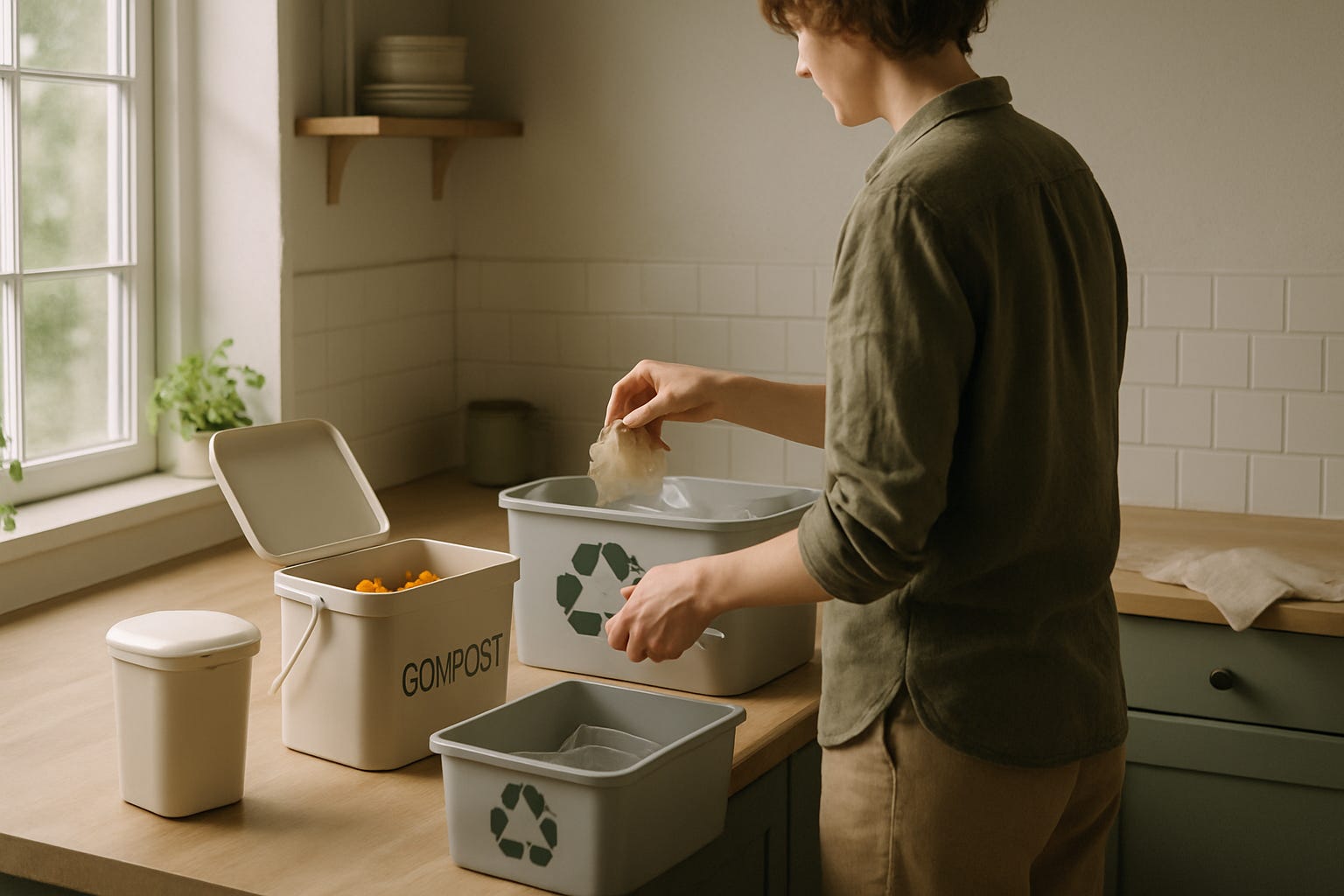
Two full trash bags a week. For the average household, that’s the baseline. It feels normal because it is normal — Americans generate about 4.9 pounds of trash per person per day, according to the EPA’s municipal solid waste data, which means a family of four produces somewhere around 700 pounds of garbage every month. The bin fills up. The bags pile by the door. You take them out. The cycle repeats.
Here’s the thing, though: a huge proportion of that garbage isn’t really garbage. According to Michigan’s Department of Environment, Great Lakes, and Energy, more than 50% of what we put out at the kerb is compostable, made up of food scraps, paper, yard waste, and wood. Another large chunk, the packaging and containers, is theoretically recyclable — though, as we’ll get into, “theoretically” is doing a lot of heavy lifting there. What’s left, the actual irreducible trash, is probably a fraction of what you’re currently binning.
Getting from two bags a week to half a bin in 30 days is an achievable goal for most households. Not comfortable, not effortless, but achievable — and the steps are more logical than they are heroic.
Week one: the waste audit you’ll only need to do once
Before you change anything, you need to know what you’re actually throwing away. This is the part most people skip because it sounds tedious, but it’s also the part that makes everything else dramatically more effective. A home waste audit takes about 30 minutes and produces information that guides every other decision in this process. 🔍
The method is simple:
Set aside all your household trash and recycling from one full week
Spread it out on a tarp or cardboard in a garage, garden, or spare room
Sort everything into rough categories: food scraps, packaging, paper and cardboard, bathroom waste, and genuinely-nothing-to-be-done-with-it trash
Make rough notes on which piles are biggest
What you find will almost certainly surprise you. Most people discover that their biggest categories are food scraps and organic waste (which could be composted) and packaging (some recyclable, some not). The pile of actual irreducible waste, the stuff with nowhere to go, tends to be much smaller than people expect.
This audit doesn’t need to be scientific. You’re not weighing things with a kitchen scale or producing a spreadsheet. You’re building a mental map of where your garbage actually comes from, because that map tells you which levers to pull first. A household that throws away mostly food scraps has a different 30-day plan than one that throws away mostly plastic packaging — and without the audit, you’re guessing.
One practical note: do the audit during a typical week, not around a birthday, holiday, or family gathering. Those weeks skew the results in ways that aren’t useful.
The food waste problem, and why composting fixes 30% of your bin overnight
Food is the single largest material in US landfills, comprising 24.1% of municipal solid waste, according to the EPA’s composting data. For a typical household, that translates directly: around a quarter of your garbage bag is almost certainly food. Worse, the average US household spends between $1,500 and $1,800 per year on food that ultimately gets thrown away, according to 2026 data compiled by Moreborn. That’s not a rounding error. That’s a monthly cost that rivals a utility bill. 🍎
Composting doesn’t reduce food waste — it redirects it. The food still gets used, just by soil bacteria and worms instead of a landfill. Even a basic composting setup diverts the entire food scrap stream out of your general waste bin, which by itself can cut your garbage volume by roughly a quarter to a third.
The practical options depend on your setup:
A garden or outdoor space: a standard compost bin or heap handles virtually all organic waste. The NRDC’s composting guide is the most thorough plain-English resource available on this
A flat or apartment with a balcony: a small worm bin (vermicomposting) works well, stays odour-free when maintained properly, and produces excellent liquid fertiliser as a byproduct
No outdoor access at all: most urban areas now have compost collection programs, community drop-off points, or services that collect food scraps. A sealed countertop container keeps scraps odour-free between drop-offs
But composting is only half the food waste equation. The other half is not creating the food waste in the first place. The University of Michigan’s Center for Sustainable Systems estimates that about a third of all food in the US is wasted, and most of that waste happens at home. Meal planning for the week before shopping, buying only what you have a plan to use, and storing food correctly so it actually lasts — these habits reduce both the compost pile and the grocery bill simultaneously. Greeninch has a practical breakdown of this in 6 ways to eat sustainably without going vegan, which covers the food-waste side of sustainable eating in more depth. 🌱
The recycling trap: why doing it wrong fills your bin instead of emptying it
Here’s the uncomfortable truth about recycling: a lot of what goes into blue bins ends up in landfill anyway, and some of what you’re throwing in the recycling is actively making the problem worse. Wishcycling — putting something in the recycling because you hope it’s recyclable rather than because you know it is — contaminates entire batches of legitimately recyclable material, sometimes causing whole loads to be rejected and landfilled. The average contamination rate in recycling collections is around 17%, according to Routeware’s analysis of recycling program data. In some areas it runs above 25%.
The items most commonly wishcycled — and most reliably damaging to recycling systems — include:
Plastic bags and film wrapping: these tangle in sorting machinery and cause shutdowns. Almost no curbside program accepts them; many supermarkets have separate soft-plastic drop-offs
Greasy pizza boxes: the oil contamination makes the cardboard unrecyclable. Clean cardboard from the same box? Fine. The greasy base? General waste
Coffee cups: most takeaway cups have a plastic lining that standard recycling can’t process. They belong in general waste or specialist collections
Shredded paper: too small for most sorting machines. It ends up as contamination even if the original paper was perfectly recyclable
The practical fix is a five-minute exercise: look up your local council or municipal authority’s specific recycling guidelines. Every area is different. Knowing your actual rules — rather than operating on a general sense that “most plastics are recyclable” — is what converts wishcycling into actual recycling. When in doubt, the New Hampshire Department of Environmental Services puts it simply: when you’re not sure whether something is recyclable, throw it in the trash. A wrongly-recycled item does more damage than a correctly-binned one. ♻️
Have you ever checked your local authority’s exact recycling guidelines? It’s probably been a while — and they change more often than you’d think.
The packaging problem: buying less of it in the first place
Containers and packaging make up the single largest category of US municipal solid waste by tonnage, at 28.1% of total generation, according to EPA data. A lot of that packaging is unavoidable — the egg carton, the milk bottle, the pasta bag. But a meaningful share of it is the result of shopping habits that default to individually packaged, single-use convenience formats when alternatives exist. 🛒
The 30-day exercise here is deliberately modest: you’re not overhauling your shopping. You’re identifying two or three categories where packaging waste is high and where a simple swap exists.
Common high-yield swaps that reduce packaging waste without much inconvenience:
Buying loose fruit and vegetables instead of pre-packaged bags (same product, no packaging)
Switching one or two cleaning products to refillable or concentrate formats
Buying a larger size instead of multiple smaller sizes of the same product
Choosing products with single-material packaging (cardboard, glass, tin) over multi-layer plastic composites, which are rarely recyclable
Greeninch’s piece on 10 everyday swaps to cut plastic waste goes through the practical mechanics of each of these in detail and is worth reading alongside this one.
The key mindset shift here is moving the reduction upstream. Recycling is something you do after waste exists. Buying differently means the waste never enters your home in the first place — and nothing reduces your bin volume faster than that.
What 30 days actually gets you, and where to go after
By the end of the first month, a household that has completed a waste audit, started composting or diverting food scraps, fixed its recycling habits, and made a handful of packaging swaps typically produces somewhere between 40% and 60% less general waste than it did at the start. The numbers vary widely depending on starting point and family size, but the direction is reliable. 📉
The four changes work because they attack the four biggest categories in most household bins simultaneously. Food scraps leave through composting. Recyclable materials leave through recycling that actually works. Some packaging never enters the house at all. What’s left — the real, irreducible trash — is a much smaller pile than it appeared at the start.
After month one, the highest-impact remaining levers tend to involve:
Bathroom waste: cotton pads, disposable razors, plastic toothbrushes, and single-use packaging from personal care products make up a surprising share of household trash once the kitchen is sorted
Paper and junk mail: most of it is recyclable, but registering for mail preference services to stop receiving it is more effective than recycling it after the fact
Food packaging from convenience and takeaway food: the one category where changing habits is genuinely difficult, because it involves changing behaviour in high-stress, low-decision-making-capacity moments
The 30-day plan won’t get you to zero waste. Zero waste is a philosophy and a direction, not a destination most people reach in a month. But half a bin? That’s genuinely achievable, and once the new habits are automatic — once the compost container lives by the sink and the correct recycling rules are memorised and the loose produce habit is embedded — maintaining it takes no more effort than filling two bags a week did before.
Which part of your current waste stream do you think would shrink the most if you looked at it closely: food scraps, packaging, or recycling mistakes?