

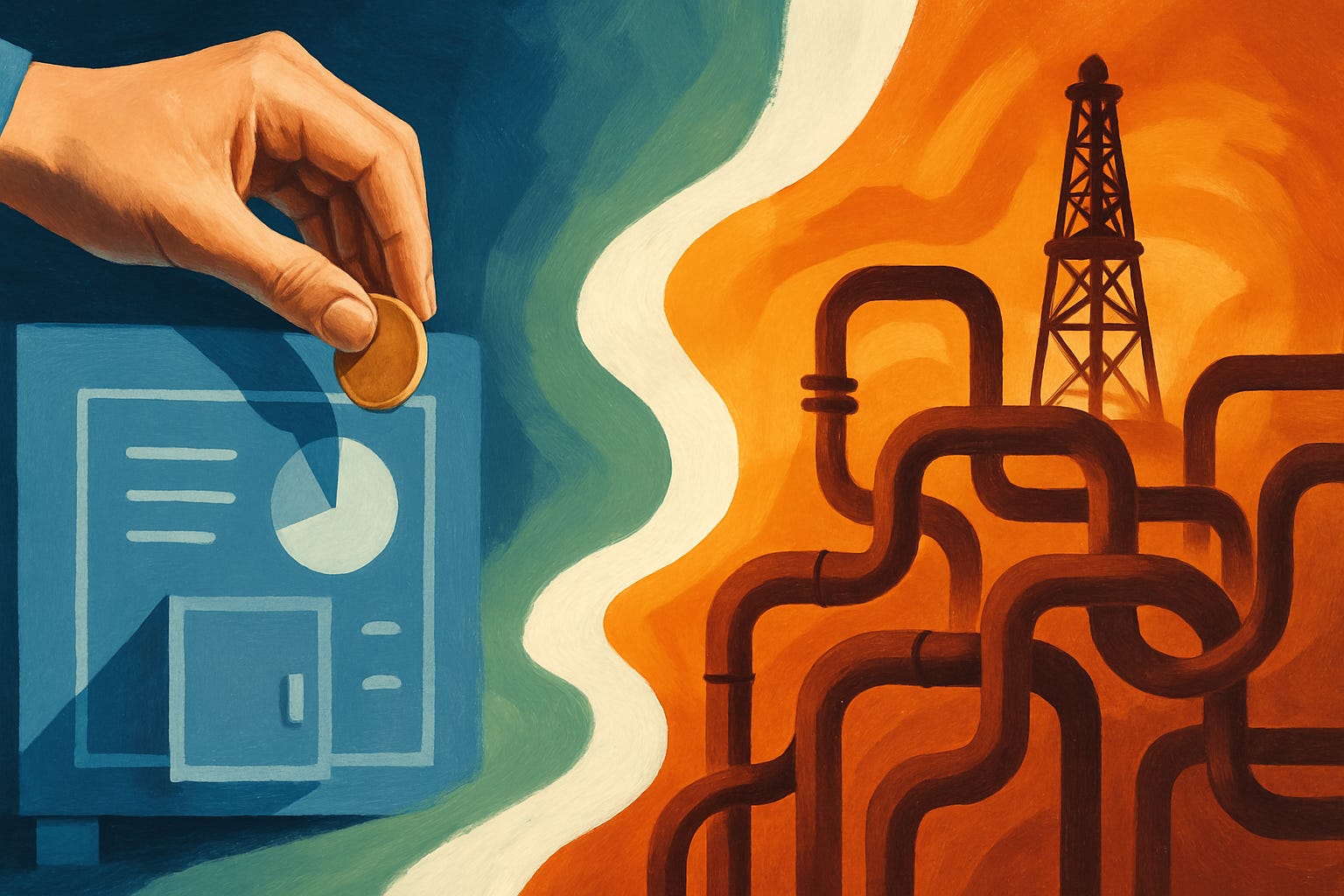
Here’s an uncomfortable fact most people never think about: the money sitting in your checking account isn’t just sitting there. Banks lend it out, and a huge amount of that lending goes to oil, gas, and coal companies. The world’s 65 largest banks committed $906 billion to fossil fuel companies in 2025 alone, an 8% jump from the year before, according to the Banking on Climate Chaos 2026 report. 🏦 Since the Paris Agreement was signed a decade ago, that same group of banks has funneled $8.7 trillion into oil, gas, and coal operations. You can recycle every bottle you own and still be, indirectly, one of the financiers of the fossil fuel industry, simply by keeping your paycheck in the wrong place.
What your deposit is actually doing
A bank account doesn’t work like a safe deposit box. When you deposit $1,000, the bank doesn’t set it aside for you. It lends most of that money out, often at a ratio far higher than what it keeps in reserve, and it earns interest on those loans while paying you a fraction of that back. Where the loans go depends entirely on the bank’s lending policy, and for most major banks, a meaningful chunk of it goes toward fossil fuel expansion. 🛢️
The scale here is genuinely hard to picture:
JPMorgan Chase remains the world’s single largest fossil fuel financier, providing $58 billion in 2025 alone, up over 12% from the year before
Bank of America and Japan’s Mitsubishi UFJ Financial Group round out the top three
Twelve banks, the so-called “Dirty Dozen,” account for nearly 40% of all global fossil fuel financing
Financing specifically for fossil fuel expansion (new pipelines, new drilling, new LNG terminals) jumped 27% in a single year
None of this shows up on your monthly statement. That’s the whole problem. Your money is doing something with every day that passes, whether you’ve thought about it or not.
How to check where your own bank stands
Before switching anything, it’s worth finding out exactly where your current bank falls. You don’t need to comb through annual reports to figure this out anymore. A handful of independent research tools exist specifically for this. Mighty Deposits lets you search by bank name and see whether it’s fossil-free certified, a member of the Global Alliance for Banking on Values, or a certified B Corp. Bank.green runs a similar lookup and maintains its own Fossil Free Certification, awarded to institutions that have formally pledged not to lend to fossil fuel extraction or infrastructure. 🔍
A few things worth checking for any bank, current or prospective:
A published, specific fossil fuel exclusion policy, not just a vague sustainability mission statement
Third-party certification (B Corp, GABV membership, or Fossil Free Certified) rather than self-issued claims
FDIC or NCUA insurance, so you’re not sacrificing basic deposit protection for values alignment
A public impact report showing where loans actually went, not just where the bank says it wants to go
If you’d rather see this at the level of individual purchases, our roundup of tech tools that help you live greener covers a few fintech apps that show the carbon footprint tied to your everyday spending, which is a slightly different angle but comes from the same instinct: knowing where your money actually goes.
Watch for greenwashing in your statement
Banking has its own version of the leaf logo on a plastic bottle. A bank can plant trees, print statements on recycled paper, and put solar panels on its headquarters while still pouring billions into pipeline financing behind the scenes. Sustainable banking is a specific, checkable claim about lending policy. It is not a marketing department’s mood board.
We wrote at length about spotting exactly this kind of gap between marketing and substance in our breakdown of legitimate eco certifications, and the same skepticism applies here. Signs a bank’s green claims deserve a second look:
Language about “environmental responsibility” with no specific fossil fuel policy attached
Carbon-neutral claims built on offsets rather than actual changes to lending behavior
No named third-party certification, just internally designed badges
A sustainability page that talks about the building and the branches, never the loan book
Ask directly, if you have to: does this institution lend to companies drilling, mining, or building fossil fuel infrastructure? A bank with a real policy will have a specific, public answer.
Switching without blowing up your finances
The idea of moving banks sounds like a weekend lost to paperwork, but it’s genuinely more manageable than most people assume, and you don’t have to do it all at once. 💳
A sequence that avoids disrupting your life:
Open the new account first, before touching the old one, so there’s zero gap in access to your money
Move a small recurring transaction over first, like a streaming subscription, just to test the new account works as expected
Redirect your direct deposit once you’re confident the account is working properly
Update autopay for bills one at a time rather than all in a single afternoon
Keep the old account open with a small buffer for a month or two until everything has fully migrated
Close the old account last, and tell them why, since customer feedback genuinely does get tracked internally
Community-focused credit unions are often the simplest option, since by their nonprofit, member-owned structure they tend to keep deposits local rather than funneling them into large-scale fossil infrastructure. That’s not a guarantee on its own though, so it’s worth checking a specific credit union’s policy rather than assuming small automatically means clean. Have you actually looked up your own bank yet? It takes about two minutes.
It doesn’t stop at your checking account
Your retirement account and any index funds you hold are worth a look too, and honestly this is where the bigger numbers often hide. Standard index funds frequently carry a meaningful stake in fossil fuel companies by default, simply because the index includes them. Tools like Fossil Free Funds, maintained by the campaign group behind Fossil Free California’s Move Your Money project, let you check exactly how much of your existing 401(k) or brokerage holdings are tied to oil, gas, and coal, and point toward fund alternatives that screen those companies out. 📈
This part usually matters more in dollar terms than your checking account ever will, since retirement savings tend to dwarf whatever’s sitting in a savings account day to day. It’s also the part people check last, mostly because it feels more complicated than it actually is.
Pull up your bank’s fossil fuel policy today, even just to see if one exists. If it doesn’t, that’s your answer.