

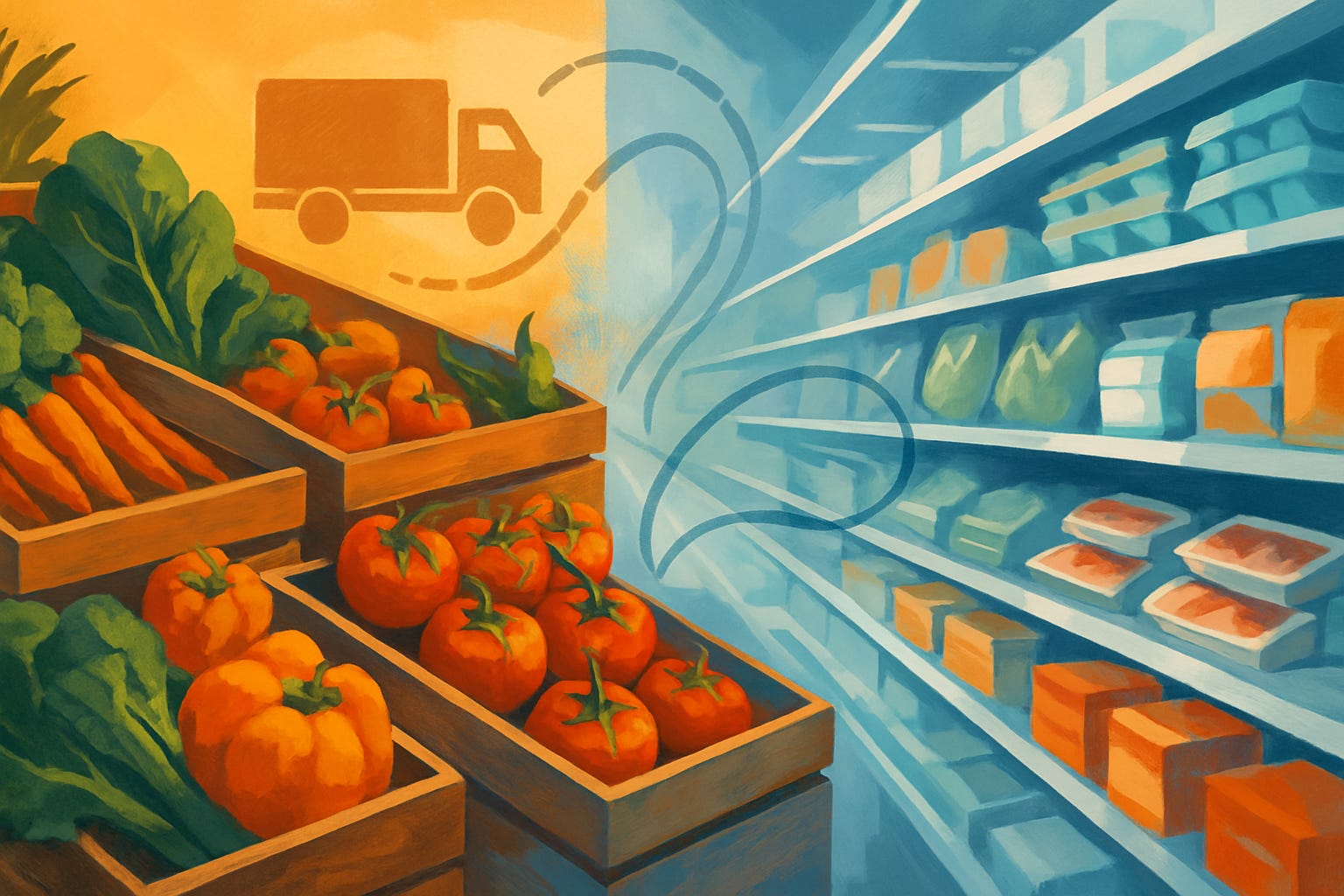
I used to think the answer was obvious. Farmers markets: good. Supermarkets: bad. Case closed, right? 🥕 Then I actually dug into the research, and it turns out the truth is messier than a canvas tote bag full of kale. Supermarkets have brutal logistical efficiency on their side, built from decades of engineering. Farmers markets have short supply chains, minimal packaging, and soil-friendly farming, but they also ask you to drive somewhere extra, and that drive counts.
So which one wins? I think the honest answer is it depends on what you’re buying, how you get there, and what happens to the food that doesn’t sell. Let’s break it down.
The food miles argument doesn’t add up the way you’d expect
For years, the pitch for farmers markets has been simple: less distance traveled means fewer emissions. It makes intuitive sense, and it is often true for a single tomato. But a 2022 analysis found that global food transport emissions are actually 3.5 to 7.5 times larger than earlier estimates, responsible for nearly a fifth of all food-system emissions, according to a widely cited 2022 study. That sounds like a slam dunk for local food, at first glance. Except the same research found something inconvenient: eliminating international food transport entirely would only cut food-related emissions by roughly 9%, <cite index=”13-1”>since transport is just one slice of a much bigger emissions pie that also includes growing fertilizer, feed, and machinery</cite>.
Translation? Distance matters, but it is not the main event. What a farm grows, how it grows it, and how it travels once it leaves the farm matter more than the number on the odometer, as Wikipedia’s overview of the concept lays out pretty clearly. A tomato grown in a heated greenhouse ten miles from your house 🌡️ can easily have a bigger footprint than one shipped from a sunny field a thousand miles away, because heating a greenhouse burns serious energy.
A few things that shape a food’s real footprint more than mileage:
The mode of transport (a container ship is wildly more efficient per pound than a diesel truck 🚚)
Whether the item needed heating, cooling, or refrigeration along the way
How the farm itself was managed, including fertilizer use and tillage
What percentage of the shipment actually gets eaten, versus lost or tossed
How the shopper gets to the point of sale, which we’ll get to in a minute
None of this means “buy local” is wrong. It means the food miles pitch, on its own, oversells the case. 📦
Packaging waste is where farmers markets genuinely pull ahead
If food miles are a wash, packaging is not. Walk through a supermarket produce aisle and you’ll find cucumbers wrapped in plastic, herbs in clamshells, and apples on foam trays. Walk through a farmers market and most of that plastic simply disappears, because vendors sell straight out of bins, baskets, and paper bags 🧺. Farmers markets typically generate less packaging waste than supermarkets, <cite index=”6-1”>since goods are usually sold in bulk or with minimal wrapping instead of the layers of plastic, styrofoam, and cardboard common at conventional grocery stores</cite>.
That difference adds up fast once you’re buying groceries every week.
Bring your own bags and containers and you can walk out with almost zero single-use plastic
Vendors selling eggs, honey, and baked goods will often let you reuse or return containers
Less packaging means less fossil fuel spent making the packaging in the first place
Some supermarkets are catching up, piloting bulk bins and reusable produce bags in select stores
I’ll admit the packaging win isn’t universal. Some markets sell jam in single-use plastic tubs or wrap cheese in more plastic than you’d expect. But on average, the shopping bag test alone tends to favor the market. Have you noticed how much lighter your recycling bin gets on farmers market weeks? ♻️
But the drive there can erase the benefit
Here’s the part that ruins the tidy narrative. If you drive fifteen minutes out of your way to reach a market that’s only open two hours a week, and you’d otherwise walk or make one quick stop at a supermarket on your normal route, that car trip might cancel out everything you just saved on packaging. One widely cited comparison in sustainability coursework points out that it can be more fuel-efficient, from a total consumption standpoint, to drive one mile to a supermarket stocking imported beef than to drive forty miles to a market selling beef raised nearby, <cite index=”10-1”>since most shoppers rely on a personal vehicle to get their groceries, and that trip is part of the real footprint, not separate from it</cite>.
This is the piece most farmers-market cheerleading skips entirely. 🚗
Ways to make sure the trip doesn’t cancel out the good you’re doing:
Combine errands. Hit the market on a day you’re already out, not a special trip
Walk or bike ⛽🚴 if the market is close enough. This is the biggest lever you personally control
Buy enough to make the trip worth it, rather than one bunch of carrots
Carpool with a neighbor who shops the same market
Does your own market require a dedicated drive, or is it genuinely on your way? If it’s the former, it’s worth running the numbers before assuming you’re doing the planet a favor.
Where farmers markets genuinely win: freshness, food access, and food waste
This is the category that tips things back in the market’s favor, and it rarely gets enough attention. Supermarket food loss is enormous. Because grocery chains stock deep and wide to keep shelves looking full, USDA researchers estimate average loss rates for fresh vegetables at roughly 11.6%, with some produce like papayas losing over 43% between the warehouse and the checkout, according to USDA’s own loss estimates. <cite index=”27-1”>These figures come from comparing pounds of shipments received by grocers against what customers actually bought</cite>. Farmers market produce, by contrast, is usually picked within a day or two of sale 🥬 and sold directly, with far fewer hands and far fewer chances to spoil in transit.
There’s a human side to this too. Roughly half of U.S. farmers markets now accept some form of federal food assistance, and programs like California’s Market Match double the value of that assistance when spent on fresh produce, <cite index=”8-1”>helping close the access gap for shoppers without an easy commute to a well-stocked supermarket</cite>. That’s not a small footnote. Food access shapes real health outcomes, and a market working to reach underserved shoppers is doing something a big-box chain often isn’t built to do. If you want to find one near you, USDA’s national farmers market directory is searchable by ZIP code. 🧑🌾
Where farmers markets tend to have the edge:
Lower food loss, since produce moves from farm to shopper in a day or two
Support for smaller, often organic or regenerative farms that build healthier soil over time
Better access programs for lower-income shoppers in many regions
Direct relationships with farmers, so you can actually ask how something was grown
Seasonal eating, which nudges you away from energy-intensive, out-of-season imports
If you’re trying to shop smarter across the board, not just at the market, our guide to sustainable food hacks that don’t break the bank is a good next stop, and avoiding greenwashing at the register will save you from a few labels that sound greener than they are.
So which one wins? Neither gets a clean sweep. Supermarkets are more efficient at moving food long distances without wasting fuel per pound, but they lose an alarming amount of that food to spoilage and overstocking. Farmers markets cut packaging and food loss dramatically, but only if you get there without burning a tank of gas to do it. My actual approach, and probably the least satisfying answer I can give you: shop the market for what’s in season and walkable, lean on the supermarket for staples and pantry goods, and skip both when a plant-forward meal does the job just as well.
What does your own grocery routine actually look like once you add up the miles, the bags, and what ends up in the trash? 🌱