

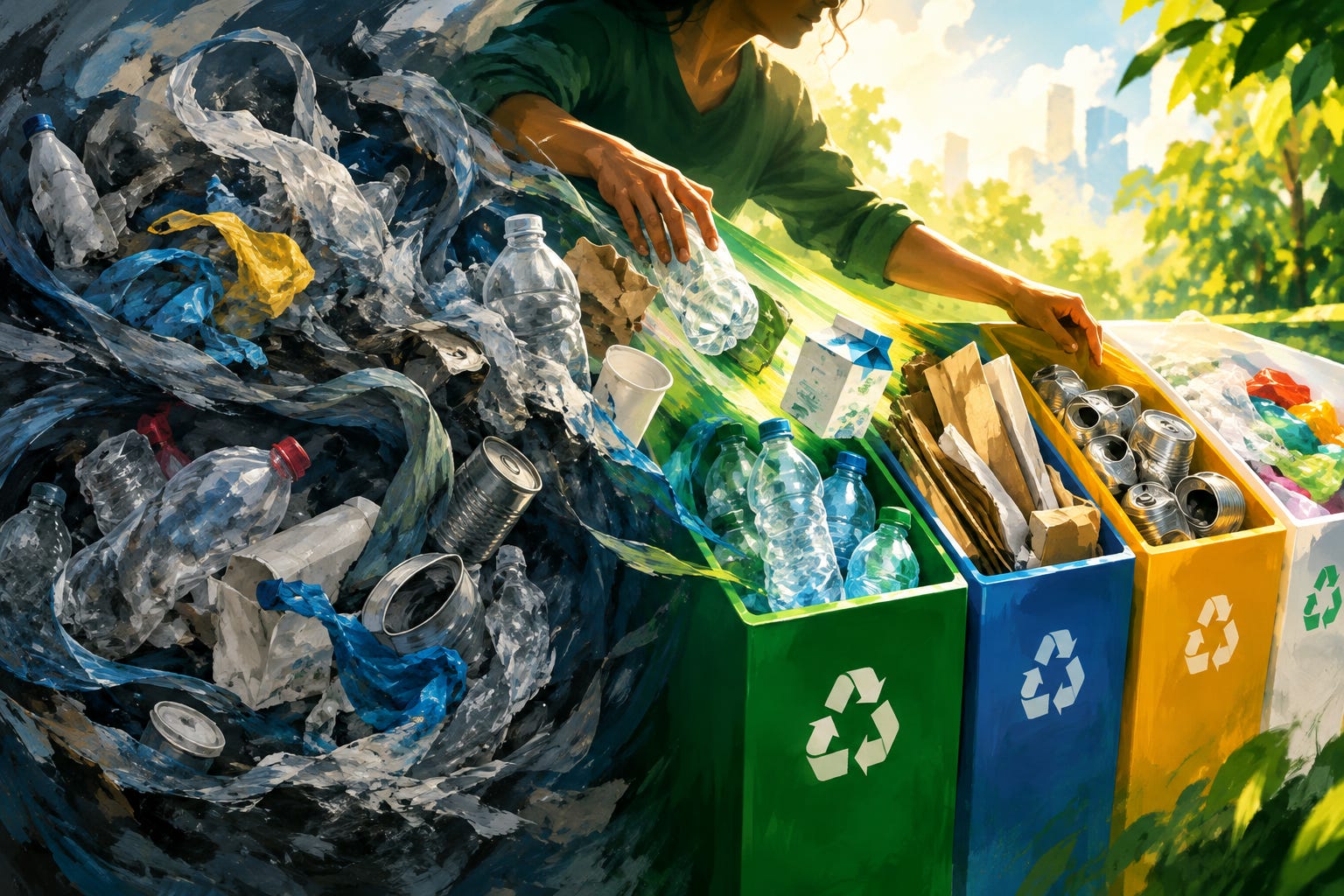
Here is an uncomfortable fact about the blue bin. It is not a magic portal. Nothing you toss in goes through a shimmering door and comes out as a park bench. A person or a machine has to sort it, and both of them have a bad day when we guess wrong. 🗑️
The industry has a name for this guessing: wishcycling. You hold a greasy takeout lid over the bin, think “it’s probably fine,” and let go. I have done it. You have probably done it too. In its 2020 curbside report, The Recycling Partnership found that the average contamination rate in communities that track it is about 17 percent. That is roughly one wrong item in every six. 😬
The good news is that the fixes are small. Here are seven mistakes, and what to do instead.
Plastic bags and the tangle gang
Mistake one: plastic bags. The EPA says loose bags can harm recycling machinery, and they are the number one troublemaker at most sorting plants. They wrap around the equipment like spaghetti on a fork. Workers then have to stop the line and cut them free by hand. ♻️
Mistake two: anything long, stringy, or floppy. Garden hoses, extension cords, holiday lights, and old sheets all do the same thing a bag does, only bigger. Facilities call these tanglers, and the WCCO report on recycling centers lists them among the biggest culprits for jammed equipment.
What to do instead:
Return clean, dry bags and film to the bins at many grocery stores 🛍️
Reuse bags until they fall apart, then drop them at the store
Take old cords and lights to an electronics drop-off, or put them in the trash
Keep a sturdy tote by the front door so the bag never enters your house
Which of those is your household’s weak spot? Be honest. Mine is the bread bag.
Bagged recyclables and dirty containers
Mistake three: bagging your recycling. It feels tidy. It is a problem. Workers cannot see inside a closed bag, so it gets picked out and sent to landfill with everything in it, according to Green Employers’ guidance from the Australian wishcycling interview with Planet Ark. Dump the items loose into the bin and keep the bag at home. 📦
Mistake four: food and liquids left in containers. One half-full jar of pasta sauce can spoil paper that was perfectly good. You do not need to scrub. A quick rinse, a shake, and a few seconds with a spatula are enough. 🍝
A simple routine:
Empty every liquid before the container goes in the bin
Rinse once, then stop. Clean enough is the goal, not spotless
Put the cap back on bottles if your local program asks for it
Toss anything caked with food that will not rinse off
If your bin has a weekly mess, a small tub by the sink for rinsed items makes this nearly automatic. 💧
Pizza boxes and foam
Mistake five: pizza boxes, all or nothing. People argue about this one like it is politics. The honest answer is it depends on the box. The EPA says clean portions of the box can be recycled, while the food-soiled parts should go in the trash. Tear the lid off, check the grease, and split it. The top is often fine, and the bottom is often not. 🍕
Mistake six: foam and “compostable” plastic. Foam takeout containers and cups are polystyrene, and the EPA notes that only a few localities accept it at the curb. The recycling triangle stamped on the bottom does not change that. Compostable plastics are a separate trap. The EPA says they are not meant for recycling, so they do not belong in the blue bin either. 🧪
Quick sorting rules:
Greasy cardboard goes in the trash, or in the compost if your city takes it
Clean cardboard goes in the bin, flattened
Foam goes in the trash unless your city says otherwise
“Compostable” cups and cutlery go where your local rules send them, which is rarely the recycling bin
Batteries are the dangerous one
Mistake seven: batteries in the curbside bin. This is the one I would tape to the fridge. Lithium-ion batteries can catch fire when they get crushed or punctured, and that can happen on a truck or at the plant. The WCCO report quoted above calls them far more dangerous than plastic bags. 🔥
You will find them in more places than you think. Think vapes, wireless earbuds, power tools, and the greeting card that plays a song. ⚡
What to do instead:
Take batteries to a retailer, hardware store, or library with a drop box
Use the Call2Recycle locator to find the closest drop-off
Tape the terminals of loose batteries before you carry them
Never throw a swollen or damaged battery in a bin of any kind
Do you have a drawer of dead batteries? Most of us do. Today is a fine day to empty it. 🔋
Stop guessing and check your local list
There is a pattern behind all seven mistakes. We guess, because the rules feel arbitrary. And they are partly arbitrary, since the U.S. has no single national program and each town sets its own list. A symbol on the package tells you the plastic type and not whether your truck takes it. 🌍
Cities that push on this see real results. Akron, Ohio cut its contamination rate from 39.3 percent before its Recycle Right campaign to 12.5 percent. Education works. Your own bin counts too. 📈
A few habits that help:
Find your city’s accepted-items list and save it on your phone
Skim the state guide too. South Carolina’s Dirty Dozen list is a good example of what such guides look like
Put a printed list near the bin
Use the old line: when in doubt, leave it out
Leaving something out feels wrong at first, like you are giving up. You are not. A cleaner bin means the good stuff actually gets recycled. 🌱
So here is my question for you. Which of these seven will you fix first, and who in your house needs to hear about it?