

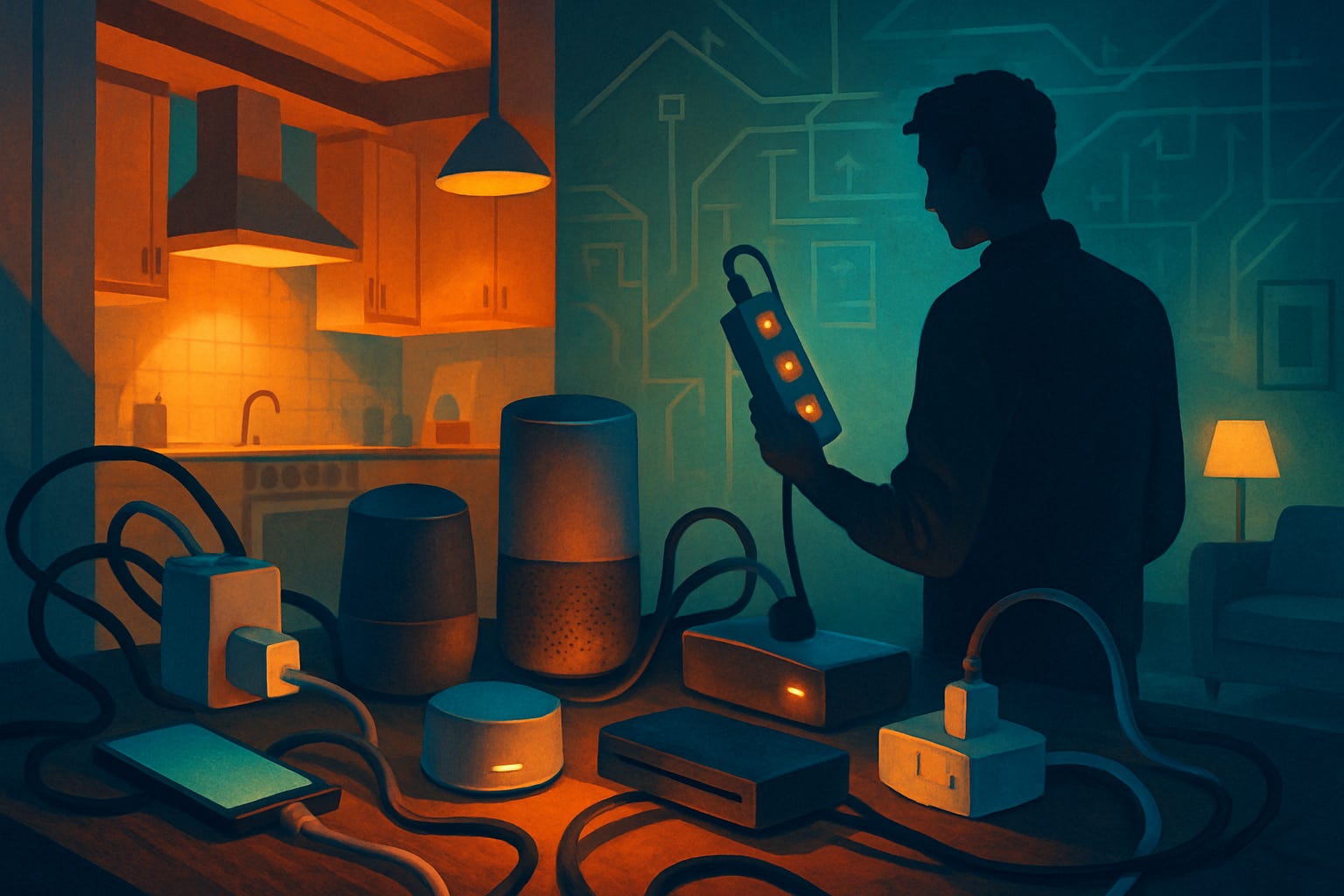
Your TV isn’t watching anything right now. Your phone charger has no phone attached to it. And yet, somewhere in your walls, electricity is still moving. 🔌 This isn’t a glitch. It’s a feature of modern electronics, and it has a name almost as dramatic as it sounds: the energy vampire.
I don’t love a spooky metaphor that overstays its welcome, but this one earns its keep. These devices really do sip power around the clock, whether you’re home, asleep, or on vacation. And the math adds up faster than most people think.
What’s actually draining your wallet
Here’s the part that surprises people: an “off” button rarely means off. Most modern electronics sit in standby mode instead, quietly waiting for a remote signal, a clock to keep, or a wifi connection to hold. That waiting costs electricity, and the U.S. Department of Energy has confirmed that standby power accounts for 5 to 10 percent of residential energy use.
Put a number on that, and it stings a little more. Recent estimates put the average U.S. household’s phantom load cost at up to $183 a year, and a Cornell University analysis puts the figure even higher, closer to $200 annually. Multiply that across the country and you get a genuinely huge number: a National Resources Defense Council report found Americans collectively spend $19 billion a year powering devices they’re not actually using. 💸
Quick facts worth sitting with:
Standby power eats 5-10% of a typical home’s electricity use
The average household loses $100-$200 a year to phantom loads
Nationally, that adds up to billions in wasted electricity
Most homes have somewhere between 20 and 40 devices doing this at once
None of this is your fault, exactly. Manufacturers design devices to stay half-awake because it’s convenient. Your smart speaker needs to hear you. Your router needs to stay connected. But convenience has a price tag, and it’s been quietly showing up on your bill for years. ⚡
The seven vampires haunting your home
Not every device is an equal offender. Some sip a trickle, others draw enough to notice on a watt meter. Based on what utilities and energy researchers flag most consistently, here are the seven worst repeat offenders:
TVs and cable or satellite boxes — these are near the top of every vampire list because they’re built to respond instantly to a remote, which means the receiver circuit never fully powers down
Game consoles — left in “instant on” or rest mode so you can jump back into a game, these can draw almost as much power idle as many laptops draw while working
Phone, laptop, and tablet chargers — a charger left plugged into the wall keeps pulling a small current even with nothing attached, and nobody remembers to unplug these
Desktop computers and monitors — even a laptop that’s shut down completely can still draw a trace of vampire power if it’s plugged in, and desktop towers with external power supplies are worse
Printers and scanners — they stay “ready” so you never have to wait, which means the internal electronics never actually rest
Coffee makers and microwaves with digital clocks — that little glowing display isn’t free, and it’s on 24 hours a day, 365 days a year
Wifi routers and modems — these are usually meant to stay on, but older or poorly rated models can draw far more standby power than newer ENERGY STAR-rated units
If you want to play detective, look for the tiny glowing lights scattered around your living room after everything is “off.” 👻 Every one of those is a small confession.
How to catch them in the act
Guessing which device is the worst culprit is a bit like guessing which candle is burning the fastest. You can eyeball it, but a real reading beats a hunch every time.
A few low-effort ways to actually measure the damage:
Plug-in watt meters (sometimes called kill-a-watt meters) show real-time and cumulative energy draw for anything plugged into them, usually for under $30
Smart plugs with energy monitoring do the same job and let you track usage from an app over days or weeks
A visual sweep at night — walk your house after everything’s “off” and count the glowing standby lights; each one is a device still drawing power
Your utility’s online usage dashboard, if it offers hourly or 15-minute data, can sometimes reveal a baseline “always-on” load that never drops to zero
Here’s a small experiment worth trying this week: unplug everything in one room except your fridge equivalent (or nothing, if it’s not a kitchen) before bed, then check your smart meter or watt meter reading in the morning versus a normal night. The difference is your vampire load for that room. Kind of satisfying, honestly. 🔋
Garlic, stakes, and smart plugs: what actually works
Knowing the problem is one thing. Fixing it without turning your home into an inconvenient mess is another. The good news is that most solutions take minutes, not hours.
Use smart or switched power strips to cluster entertainment centers, home offices, or kitchen counters, so one flip truly cuts power to everything plugged in
Unplug rarely-used chargers and small appliances instead of leaving them dangling in the outlet between uses
Enable power-saving or eco modes on TVs, consoles, and computers instead of relying on standby
Shop for the ENERGY STAR label when replacing electronics, since certified products are specifically built with lower standby power draw than comparable non-certified models; the ENERGY STAR product finder is a solid place to compare before buying
Check your router and modem’s settings for a scheduled low-power mode overnight, if your internet provider supports it
For a deeper dive into the math, EnergySage’s breakdown of phantom loads walks through cost estimates by device type, and Natural Resources Canada’s guidance on vampire power covers similar ground for Canadian households, where the percentages track closely with U.S. numbers. If you want the government’s own tips straight from the source, the Department of Energy’s standby power guide lays out the same three fixes utilities keep repeating for a reason: they work.
None of this requires ripping cords out of the wall in a panic. It just means treating “off” with a little more suspicion than you used to. 🌍
So, before bed tonight: how many glowing lights are actually in your living room? Go count them, and see how many you can shut off for good.