

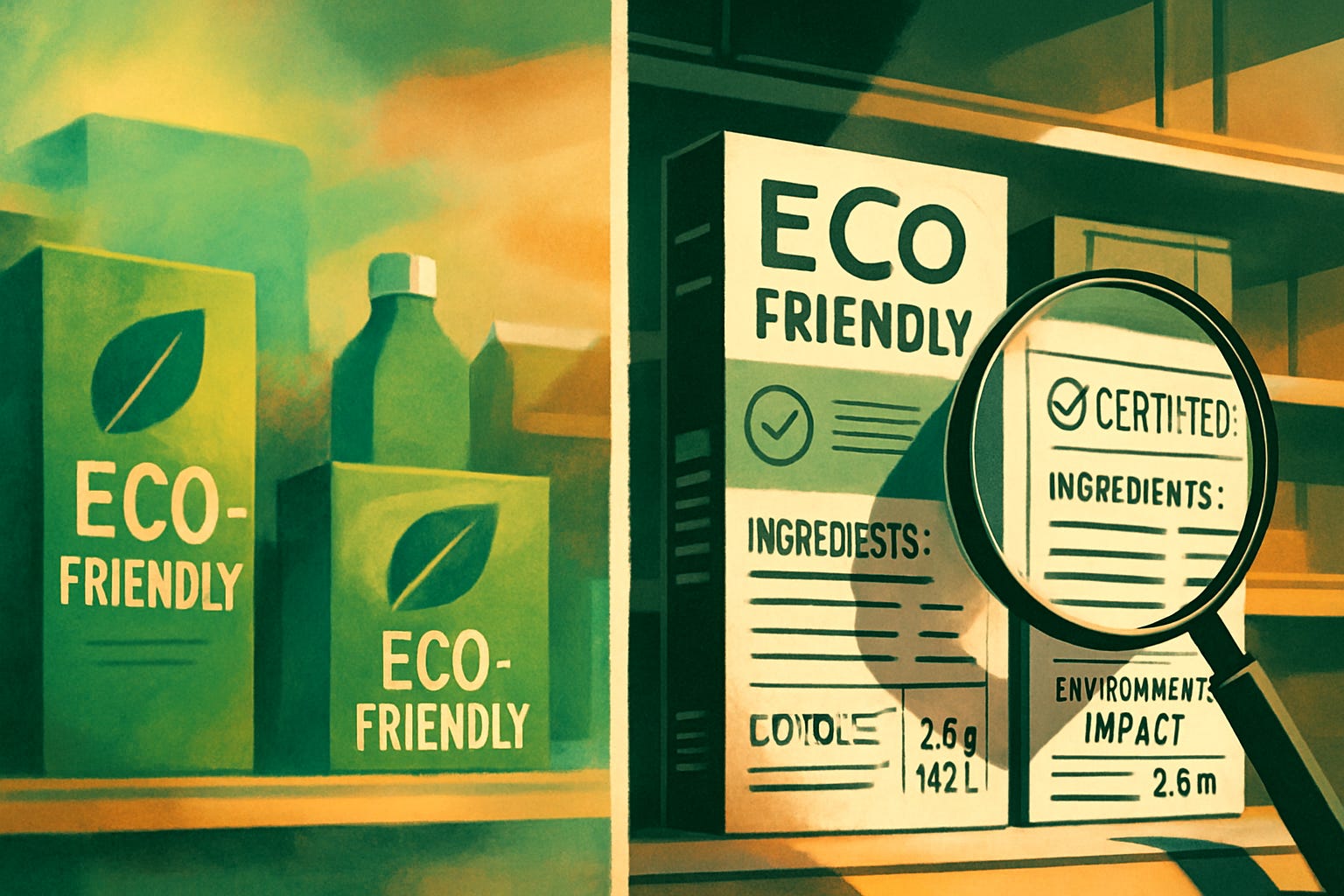
Walk down the cleaning aisle and count the leaves. Then count the auditors. The leaves win by a mile. 🍃
The gap matters more this month than usual. From 27 September 2026, the EU’s Empowering Consumers Directive bans generic claims like “eco-friendly” and “green” unless the seller can show recognised excellent environmental performance, according to the law firm Latham & Watkins. That is EU law, so it doesn’t rewrite US shelves. But it says out loud what many shoppers already suspect. Those words often mean nothing.
The suspicion is common. Business News Daily cites the World Resources Institute, which found that 53% of US consumers sometimes or never believe companies’ environmental claims. Honestly, fair. 🤨
You don’t need a chemistry degree to fight back. You need a pause and a quick flip of the package. Here are five signs to look for.
Sign 1: the label says “green” and nothing else
The most common red flag is a claim with no detail. CNN’s guide to avoiding greenwashing lists vague terms like “eco-friendly,” “green” and “nontoxic,” used with no explanation, at the top of its warning list. Companies can print those words without much proof behind them. 🌿
The fix is specifics. The EU rules treat a claim as acceptable when it is spelled out on the same package, and Latham & Watkins gives the example of packaging made from 80% recycled content. The claim still has to be true, but at least it is checkable. A percentage can be wrong. An adjective can’t even be wrong.
What to look for:
Adjective only: “eco,” “natural” or “planet-friendly” with no number or standard beside it
Specific and checkable: a percentage, a named material or a named standard
Same place: the explanation is on the package, not buried three clicks deep on a website
Empty comparisons: “greener” or “better for the planet” with no answer to “than what?” 🔍
Grab one bottle from under your sink right now. What number backs up the leaf on it? 🧴
Sign 2: the badge looks official but nobody audits it
Green branding is cheap. Business News Daily flags evocative pictures, like flowers, globes and the color green, as a classic way to imply eco credentials that the text never claims. 🌍 The EU rules also go after sustainability labels that have no certification scheme behind them, which is a polite way of describing badges a brand invents for itself.
Which labels do deserve trust? We covered that in our guide to the certifications that actually mean something. The short version is that a real label needs an outside auditor, a published standard and consequences for failing. A badge that reads “Verified by [the brand’s own name]” is a restaurant reviewing itself.
Ask these questions:
Does the badge name an independent certifier, or just the brand?
Can you look the product up in the certifier’s public database?
Is the seal’s name invented by the brand itself?
Are pictures doing all the talking while the text stays quiet? ✅
Sign 3: one green feature is doing all the work
This is the halo trick. A brand spotlights one good detail and hopes you’ll assume the rest matches. Business News Daily calls out the version where an efficient light bulb comes from a factory that pollutes rivers. 💡
The EU blacklist targets the same move. It bans suggesting that an environmental benefit covers a whole product when only one component qualifies, according to Tappr’s summary of the directive. Materials can mislead, too. National Geographic reports that the FTC sued Walmart and Kohl’s for selling rayon textiles as bamboo. Bamboo sounds gentle. Rayon is what came off the shelf. 🎋
Before you buy, check:
Which part is green: the box, one ingredient or the whole product?
Whether the claim has a number, like “made with 30% recycled,” or just “made with”
What the material really is, not what the packaging photo suggests
How the rest of the brand behaves, because a single green product from a dirty company is a small story
Sign 4: “carbon neutral” and “net zero by 2040”
“Carbon neutral” is bookkeeping. “Reduced” is physical. I think that is the tell. 📈 A product can reach neutral on paper by paying someone else to cut or absorb emissions while the product itself stays the same. National Geographic counts carbon offsets among the murkier cases of greenwashing.
The EU has decided the trick goes too far. Per ASUENE’s breakdown, a product-level “carbon neutral” claim based on offsets is blacklisted from 27 September. ClimatePartner adds that future-facing claims, like “climate neutral by 2030,” need a credible implementation plan. A date alone is a wish.
What to check:
Does the label say “reduced by X%” or just “neutral” with no method?
Is there a published plan with dates and interim targets?
Does the claim cover the product or only one step, like shipping?
Who verified the numbers, and can you find their report? ⚡
Think of a brand you love that has a net-zero date. Have you ever looked for its plan? A two-minute search is usually enough to tell.
Sign 5: “recyclable” and “compostable” with no fine print
A recycling symbol feels like a promise. It can be a wish instead. According to Third Partners’ summary of the FTC Green Guides, the current rules allow an unqualified “recyclable” claim when recycling facilities reach a substantial majority of the communities where the product sells. That is not the same as your town having them. ♻️
Compostable is trickier. PackOasis, a packaging supplier, lists “biodegradable” on packaging that needs industrial composting among the claims that trigger enforcement. It also says plastic films and multi-layer materials are hard to defend as recyclable. As far as I can tell, the FTC’s Green Guides have not received a finished overhaul since the FTC began reviewing them, so the older rules still set the tone. 🗑️
Do this at the shelf:
Look for “where facilities exist” or “check locally”, which are honest qualifiers
Check your local hauler’s accepted-materials list before trusting the symbol
Treat “compostable” as industrial composting unless the package says otherwise
Be suspicious of mixed materials, like foil-lined pouches and coated film
The habits above give you a quick test for your next purchase. Find the number and the auditor. If you can’t, put it back or buy less. Our piece on how to be more green at home makes the case that reducing consumption beats swapping brands, and these eco-friendly upgrades that pay for themselves show where spending is easier to justify. 🌱 Which claim in your cabinet would you bet your own money on?