

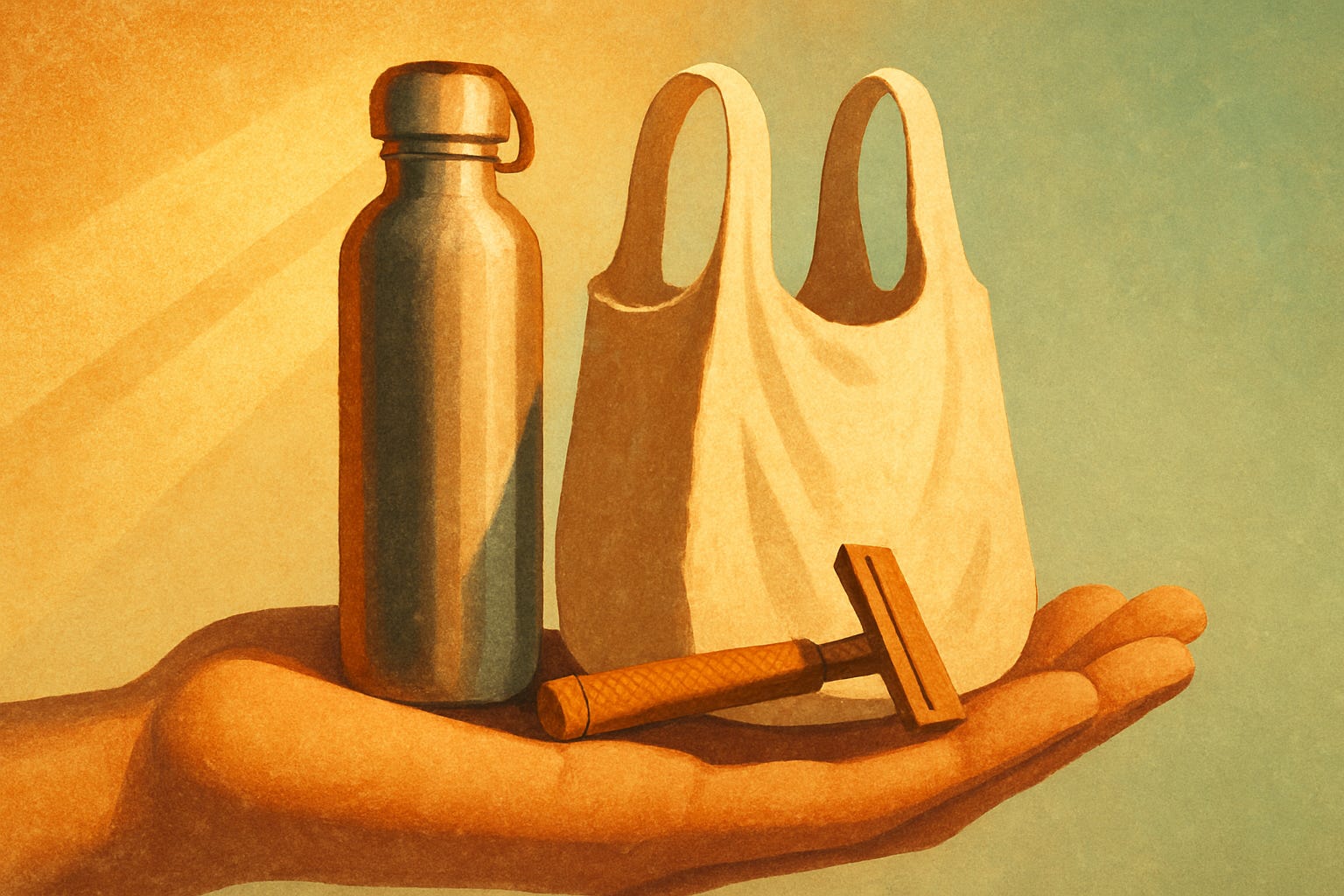
There’s a special kind of guilt in owning a reusable tote bag that’s still got the tags on it in your closet. I get it. A lot of “sustainable swaps” content out there is really just a shopping list dressed up as advice, and half the products never actually pay for themselves before they fall apart. 🙄
So I went looking for the swaps where the math is boring and obvious, not aspirational. These five aren’t the ones that save you money “someday.” They save you money by the time your next bill shows up.
A reusable water bottle pays off almost immediately
This is the easiest one to prove, and the numbers are honestly a little embarrassing once you see them side by side. One cost comparison from Choice, the Australian consumer group, found that a $40 reusable bottle beats out 156 single-use bottles a year (three a week) purchased at $1.25 each, a savings of $155 in the first twelve months alone.
And that’s the conservative version. One Reddit user who switched from buying bottled water because of bad-tasting tap water did the math on their own habit: about $1,200 a year on bottled water, versus roughly $100 a year once they added a countertop filter. That’s over a thousand dollars back in their pocket, and it took about a week of actually adding up receipts to notice. 💧
Quick math to run on yourself:
Count how many single-use bottles your household buys per week, not per day (weekly is easier to estimate accurately)
Multiply by an average price of $1 to $1.50 per bottle
Multiply that by 52
Subtract the one-time cost of a bottle you’ll actually like carrying around
Most people find the breakeven point is somewhere between two and six weeks. That’s not a long-term investment. That’s a payback period shorter than most gym memberships take to feel worth it.
A menstrual cup pays for itself before your next period
I resisted this swap for a long time out of pure squeamishness, and I’ll admit that. But the financial case here is almost impossible to argue with once you look at it plainly.
According to Mayo Clinic, the average person spends $50 to $150 a year on tampons or pads. A menstrual cup runs $20 to $40 and, cared for properly, can last six months to ten years. Even taking the higher end of the cup’s price and the lower end of typical disposable spending, you’re breaking even within a few months, and every cycle after that is essentially free.
A few things worth weighing before you buy one:
Sizing matters more than brand, and most companies size by age and whether you’ve given birth, not just “small or large”
The learning curve is real for the first cycle or two, so don’t judge it on week one
It holds roughly three times what a tampon does, which means fewer changes during the day, not just less trash
Silicone cups are the safest bet if you have sensitivities, since many are free of dyes, latex, and BPA
This isn’t a swap that requires you to change your lifestyle at all. It’s the same fifteen seconds in the bathroom, just with a product you’re not buying again next month. 🩸
Bring your own coffee cup and let the discount compound
This one’s smaller in raw dollars, but it’s also the swap that requires zero behavior change beyond remembering an object that lives in your bag anyway.
Most major coffee chains discount your order when you skip their paper cup. Starbucks knocks $0.10 off every hot or cold drink and adds bonus loyalty stars when you bring your own mug, according to one campus sustainability blog that ran the numbers. Buy a coffee daily with your own cup instead of a paper one, and that’s almost $40 a year, purely from the discount, before you even factor in what you save by brewing at home some mornings instead. Which?, the UK consumer group, found that regular coffee shop customers switching to a reusable cup could save more than £100 a year once you account for multiple daily drinks and the larger discounts some chains offer.
None of this requires giving up your coffee run. It just requires:
Keeping the cup somewhere you’ll actually see it, like the same hook as your keys
Rinsing it the night before instead of scrambling in the morning
Asking your local shop if they’ll fill outside cups, since most independents will even without a formal discount program
Treating the loyalty points as a real part of the math, since they add up quietly in the background
Small, boring, still real money. ☕
Ditch the paper towel roll for cloth
Here’s a number that surprised me: the average American household spends somewhere between $120 and $300 a year on paper towels alone, depending on brand and how liberally you use them for spills, grease, and general countertop chaos. One zero-waste swap calculator put typical paper towel spending at $180 a year, against roughly $20 for a stack of reusable cloth towels that get thrown in the wash instead of the trash. That’s about $160 back in your pocket in year one, and it doesn’t even require buying anything fancy. Old t-shirts cut into rags do the same job for free.
The math gets even more dramatic zoomed out. Americans as a country use roughly 13 billion pounds of paper towels every year, a habit that’s genuinely unique in scale compared to the rest of the world. You’re not going to single-handedly fix a national addiction to disposable towels, but you can absolutely opt out of paying for your share of it.
A few practical notes if you’re switching over:
Keep a small stash of actual paper towels for genuinely gross jobs like raw meat spills, since not everything belongs in your regular laundry
Cloth napkins do double duty as everyday napkins and light-cleaning rags
Buy a color you don’t love for kitchen rags specifically, so nobody’s tempted to use them as guest towels
Wash on a hot cycle for anything that touched raw food, same as you would a dish towel
Reusable grocery bags have the fastest payback of all
This is the smallest dollar amount on the list and the fastest to actually recoup. If your city charges a bag fee (Washington, D.C.’s nickel-a-bag policy is a well-known example, and it changed shopping habits fast enough that the city’s own environment department was surprised), skipping that fee on every trip adds up to real, if modest, savings over a year. Add in the stores that give a small discount just for bringing your own bags, and you’re looking at somewhere between $15 and $25 a year for most households, which sounds small until you realize the bags themselves often cost less than that combined.
Here’s the part that actually matters more than the fee math: reusable bags hold more, don’t rip open on the walk from the car, and mean you’re not accumulating a drawer full of crumpled plastic you’ll never fully use up anyway. That’s not a dollar figure, but it’s real.
To make it stick without relying on willpower:
Keep two or three in your car, not just by your front door, since that’s where you actually forget them
Buy the kind that folds into its own pouch, so one lives in your bag or backpack permanently
Skip the novelty ones and get boring, sturdy canvas, since it’ll outlast anything trendy
Ask your store about their specific discount, since some are more generous than the standard nickel
None of these five swaps ask you to overhaul your life. They ask you to swap one object for a slightly different object, and let the math do the rest. So which one’s already sitting unused in your closet right now, just waiting for you to actually start using it? 🌱